
Summary
I have a go in the 188 hp and 322 hp versions. Both have great regen braking and good towing capacity, but they are expensive.
I have a go in the 188 hp and 322 hp versions. Both have great regen braking and good towing capacity, but they are expensive.
- X
- copy
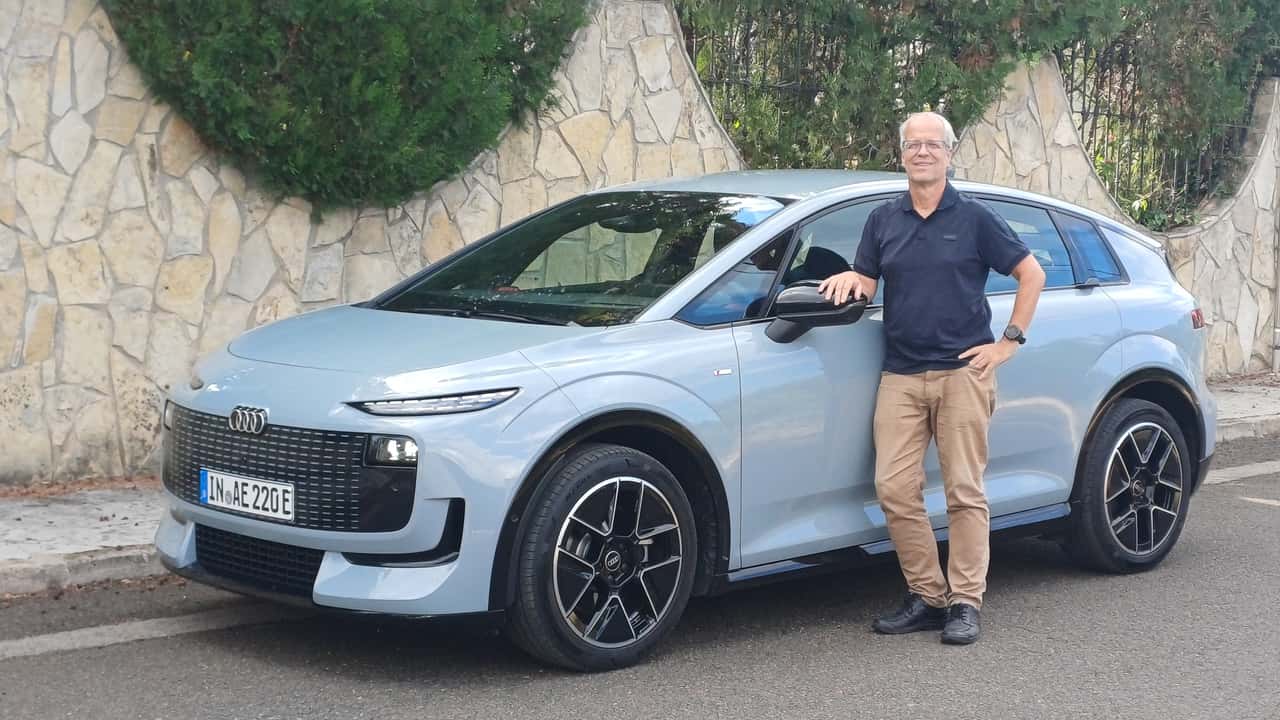
Audi has never made a Volkswagen ID.3 equivalent until now. That changed with the debut of the A2 e-tron, which boasts high efficiency, a quirky design, and a premium badge front and center.
The first A2 debuted in 1999 as a modern, aluminum-bodied, highly efficient urban car. It was supposed to be the next best thing in Europe's car market, but it didn't quite shine as Audi originally intended. That being said, is the new A2 e-tron going to experience the same fate?
I drove the newcomer in both the 188- and 322-horsepower versions to find out.
One of the standout features of the Audi A2 e-tron is its remarkably low energy consumption of only 12.8 kWh/100 km, achieved in the 188 hp (140 kW) version. Since Audi didn't have a model with this package, we settled for the standard 188 hp variant. The second test vehicle was the top model with 322 hp (240 kW), which comes with adaptive dampers.
Pros
- Very economical with the optional efficiency pack
- Good brake regen settings
- One-pedal driving
Cons
- Poor rear visibility
- Fiddly trunk floor
- You have a choice between long range and low energy consumption
- High prices
Exterior
The Audi A2 e-tron measures 169.9 inches in length, making it about 2.4 inches longer than the VW ID.3 Neo. The wheelbase is approximately the same at 109 inches for both models, similar to the Audi Q4 e-tron or VW ID. Tiguan. It's important to emphasize that the A2 e-tron is a compact car in Europe, not subcompact. The name could mislead customers.
The design of the Audi A2 e-tron is polarizing: personally, the body style isn't to my taste, as I found the first A2 unattractive. However, younger colleagues liked the new Audi.
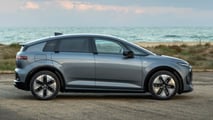
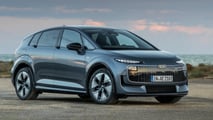
Upon seeing the new images, the car no longer appears as bulky as it did in the initial press photos, which showed the A2 e-tron in an unflattering Pistachio Green. The Arrow Gray color, which appears more like a light blue in our images, is quite pleasing.
Air Curtain openings, Gap Reducer, and Gap Breather
The bodywork is optimized for minimal air resistance. Air curtains at the front allow airflow, which exits through gap breathers behind the front wheels. Gap reducers minimize the gap between the wheel arch and tire, preventing airflow from entering and swirling inside the wheel arch. The rear spoiler also improves aerodynamics, although it reduces rear visibility, but more on that later.
The tiny door handles ensure a "clean" look on the sides
The tiny winglet handles of the A2 e-tron serve more of an aesthetic purpose than an aerodynamic one. They are easy to operate, subtly bending outward.
In the event of a power failure during an accident, ultracapacitors (a type of capacitor) in the doors provide power. However, if bystanders need to open a jammed door after an accident, it's questionable whether they can exert as much force on these tiny handles as on conventional handles.
Charging is done at the rear on the passenger side—convenient for curbside charging but less so in tight garages, where cars are often parked far right to leave room to exit on the left.
Interior and Controls
Inside, the A2 e-tron features curved dual displays with 11.9-inch and 12.8-inch diameters, respectively. The instrument display focuses on the lower part, likely because the content would otherwise be obscured by the steering wheel. The touchscreen can display a beautiful satellite view of the map upon request.
Instead of regular steering column stalks, the A2 e-tron has an unusual component behind the steering wheel for adjusting lights and wipers on the left, and activating drive modes P, R, N, D, and B on the right. The setup feels like a modern gadget, but adjusting to it requires little re-learning.
The unusual "control bar" behind the steering wheel
The version I drove featured the "Interior S" package with black integral seats and matte red details, which I could have done without—they don't quite fit. The central storage cubby with two smartphone charging trays isn't very appealing either.
However, I had no complaints about the soft wrap. In my vehicle, it consisted of black felt on the dashboard extending into the doors, where there's the typical joystick for mirror adjustment and four buttons for the window controls on the driver's side.
The button to open the doors is optimally positioned
The doors always open electrically, with a button ergonomically positioned under the armrests.
Visibility to the rear sides is okay, but the rear spoiler, which divides the rear window into an upper and lower part, spoils rear visibility. Audi's positioning of the spoiler is a trade-off between downforce and aerodynamic resistance.
A fist's width of space above the head of the 5'9" tall author
The legroom in the back is also more than sufficient
The tailgate opens wide. The trunk itself has a capacity of 396–1,336 liters (13.9-47.1 cubic feet). On the 228 hp (170 kW) version, there's also a 13-liter (0.3 cu ft) frunk available; otherwise, it's part of the storage package (priced at 320 euros). This package includes a luggage compartment insert. In its upper position, it levels the loading threshold, while in the lower position, it optimizes loading volume.
Shelf in the lower position
Shelf in the upper position with folded middle section of the backseat
However, converting it is quite fiddly: unlike in the ID. Polo, where you can flip the insert from the upper to lower position with one hand, it tends to get stuck in the A2 e-tron.
After some trial and error, I found the solution: folding the part allows it to be maneuvered from top to bottom. The test car also featured a 40:20:40 split-folding rear seat, a rare perk in this class that is part of various interior packages for the A2 e-tron.
The voice control, supported by ChatGPT, as an Audi spokesperson told me, works well. It could tell me the correct age of Chancellor Friedrich Merz and also named two local dinosaur-themed museums.
Driving Impressions
Now, onto the driving impressions. A colleague and I first drove the 188 hp version, which, along with the 228 hp variant, is expected to make up the bulk of sales.
The car accelerates well but noticeably loses power at higher speeds. Therefore, this version might not be ideal for those who frequently overtake on country roads.
The 322 hp drivetrain of the top version, which we drove next, is much more enjoyable in such scenarios. It also offers significantly higher torque at 545 Nm (402 pound-feet) compared to the 350 Nm (258 lb ft) of the APP350 motor variants.
The optional progressive steering was noticeable in the few uphill hairpin turns. The steering became suddenly more direct with strong steering input, which surprised me.
Remember, progressive steering adjusts the steering ratio (not the power assistance) to become more direct at strong steering inputs and low speeds. This technology is supposed to make maneuvering easier, as less steering input is needed.
Progressive steering is standard on the 322 hp model and part of the optional Tech Plus and Tech Pro packages for other variants.
And the suspension? Both cars experienced rear-end slip during dynamic driving and sharp steering maneuvers.
Despite the higher power, this was much less noticeable in the 322 hp version. It's unclear whether this was due to the controlled dampers or different tires (19-inch Nexen tires for the 188 hp version, 20-inch Goodyear tires for the top version).
However, this shouldn't be overemphasized: it's unlikely that anyone drives as aggressively daily as we did during testing. Nor is it necessary.
In terms of ride comfort, I found nothing to complain about during the two short drives.
I liked the regeneration settings. Using the steering wheel paddles, you can choose between D1, D2, and D3, with the B-mode selected on the right of the steering wheel. Regeneration strength increases in that order. In B-mode, the creep function is also deactivated, allowing for one-pedal driving. Additionally, there's an automatic mode where regeneration adapts to the driving situation.
The new adaptive cruise assist plus automatically stops the vehicle at red lights. However, it doesn't automatically start moving again, as assistance system specialist Patrick Werner confirmed.
After an in-depth discussion with the expert, I still don't understand why. After all, the car automatically starts moving again when stopping behind another vehicle, and the interior camera detects that you're looking forward attentively.
Audi seems cautious with new functions. If the light turns green before coming to a stop, the car continues automatically.
I didn't record the energy consumption due to the short test drive. According to WLTP figures, the 228 hp model with the efficiency package (which mainly includes a lowered suspension and low rolling resistance tires) uses 12.8 kWh/100 km, making it one of the ten most efficient electric cars.
With the 58-kWh battery, this results in a WLTP range of up to 515 km (320 miles). However, for the 228 hp version I drove, with 19-inch wheels and numerous extras, the consumption goes up to 14.5 kWh/100 km, reducing the range to 463 km (287 miles).
In the worst case, it's 15.6 kWh/100 km and 445 km.
Gallery: Audi A2 e-tron (2027) in Horizon Blue

For the version with a large 79-kWh battery and 322 hp, powered by the APP550 motor, consumption ranges from 14.2 to 15.1 kWh/100 km, with a range of 593 to 630 km (368-391 miles). Therefore, it's not possible to say that one of the two drivetrains is more efficient overall—it depends on the other equipment.
The 228 hp version comes standard with 18-inch wheels, while the top version has 19-inch wheels. The test cars had wheels one size larger, 19 and 20 inches, respectively.
It's also worth noting that all APP350 versions (all A2 e-tron except the top version) feature energy-saving silicon carbide inverters, while the APP550 of the strongest variant uses conventional silicon chips.
Additionally, Audi emphasizes that all versions of the A2 e-tron can tow 1,600 kilograms (3,527 pounds). This is indeed remarkable for a compact-class electric vehicle, and it's especially notable because the closely related VW ID.3 Neo and Cupra Born are not allowed to tow trailers—the trailer hitch can only be used for a bike rack.
Audi A2 e-tron test vehicle specs:
Prices and Rivals
The 228 hp A2 e-tron starts at 41,900 euros. The corresponding VW ID.3 Neo costs only 36,195 euros with the "ID. purchase premium," which shaves about 5,700 euros off the German list price.
The Audi's equipment isn’t necessarily better. Audi charges extra for seat and steering wheel heating (450 euros), while it's standard at VW.
Additionally, VW mirrors are not only electrically heated and adjustable but also foldable. A heat pump costs around 1,000 euros extra for both models.
Both vehicles come standard with 18-inch alloy wheels, LED lights with high-beam assist, dual-zone climate control, wireless smartphone charging, navigation system, adaptive cruise control, a basic lane-keeping assist without lane centering, front and rear parking sensors, a rearview camera, and bidirectional charging. However, the Audi has standard steering wheel paddles, a slightly larger instrument display (11.9 vs. 10.2 inches), tinted windows, and a sound system with more speakers (seven vs. five).
The top 322-hp powertrain costs 51,200 euros. There is no VW equivalent yet; one would have to wait for the ID.3 Neo GTI or purchase the Cupra Born VZ, which starts at 50,990 euros.
More premium appeal is offered by Volvo's electric SUVs, with the EX30 being slightly smaller and the EX40 slightly larger. The EX30 P5 Long Range with 268 hp is available from 43,490 euros in Germany, but it offers a maximum range of 475 km (295 miles). For the EX40 P5 Long Range with 248 hp and up to 576 km (358 miles) of range, you'll need to spend at least 53,090 euros.
Conclusion
Essentially, the Audi A2 e-tron is a VW ID.3 Neo or Cupra Born with a different body. Yes, Audi stands out with its shape, colors, equipment, towing capacity, and regeneration settings.
But it can't deny its technical foundation, and it's not more economical than its VW Group cousins per se—it all depends on the equipment. All in all, if it were my money on the line, I would rather buy an ID.3 Neo.
More Audi Stories
We want your opinion!
What would you like to see on Insideevs.com?
- The InsideEVs team
- X
- copy
Trending
Latest Stories
- Audi A2 e-tron First Drive: Does The Iconic Nameplate Live Up To The Hype? Nov 16 - First Drives -
- I Tried Mercedes' Answer To Tesla FSD. Here's How It Went Nov 16 - Tech Review -
- BMW Just Started Making EV Batteries In America. The New iX5 Will Be First In Line Nov 16 - Manufacturing / Production -
- BMW’s iX5 Beat The Lucid Gravity On Highway Range. Not On Efficiency Nov 16 - Range / Efficiency -
- Tesla Just Bumped The Cheapest Model Y’s Range, But The Price Stays The Same Nov 16 - Range / Efficiency -
- Tesla Drivers Can Now Plug In And Charge Automatically at Ionna Stations Nov 16 - Charging -
- Diesel Prices Are Surging. This Electric Trucking Company Is Seeing More Interest Nov 14 - News -
RECOMMENDED FOR YOU
Audi A4 EV Delayed Amid VW Group Financial Troubles: Report
I Tried Mercedes' Answer To Tesla FSD. Here's How It Went
The Best EV Lease And Finance Deals In November 2026
BMW Just Started Making EV Batteries In America. The New iX5 Will Be First In Line
Audi Recalls 9,048 Q4 E-Trons Because The Battery Could Catch On Fire
BMW’s iX5 Beat The Lucid Gravity On Highway Range. Not On Efficiency
Spotify’s First Native In-Car App Is Hitting Audi EVs First