
Summary
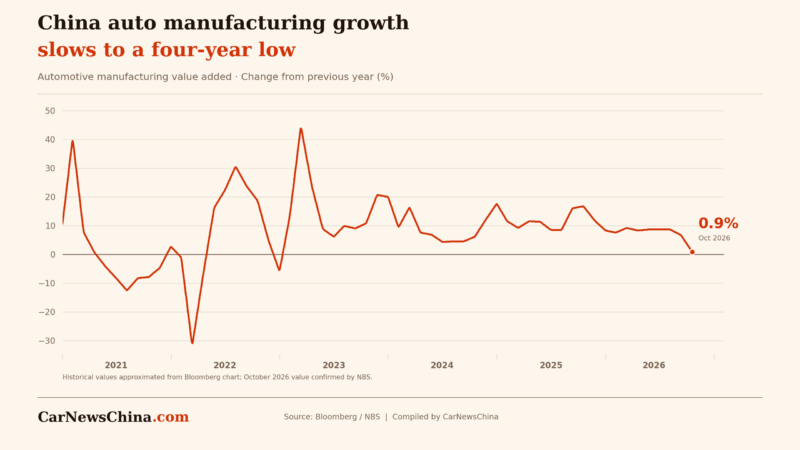
China’s automotive manufacturing growth slowed to 0.9% in October, its weakest pace since 2022, as falling domestic demand put pressure on factories despite rising exports. Passenger car retail sales declined 27.1% from the previous year, while exports increa…
China’s automotive manufacturing growth slowed to 0.9% in October, its weakest pace since 2022, as falling domestic demand put pressure on factories despite rising exports. Passenger car retail sales declined 27.1% from the previous year, while exports increased 68.5%.
The manufacturing growth figure measures the industry’s value added rather than the number of vehicles built. In other words, it shows an increase/decrease in the economic value created by China auto factories.
China produced around 3 million vehicles in October, down 7.7% from the previous year, according to National Bureau of Statistics data released on November 16. Bloomberg reported that the 0.9% increase in automotive manufacturing value added was the slowest since the Covid-related disruptions of 2022.
Production figures also showed a widening gap between new energy vehicles (BEV + PHEV) and the rest of the market. NEV output rose 17.1% to around 2 million vehicles in October, even as total vehicle production declined. Over the first ten months of 2026, China produced 26.4 million vehicles, down 4.1%, including 14.5 million NEVs, up 12.7%.
Domestic passenger car retail sales reached 1.6 million in October, according to the China Passenger Car Association (CPCA) data monitored by China EV DataTracker. Although sales increased 1.5% from September, they remained 27.1% below the previous year. January–October retail sales fell 22.3% to nearly 15 million vehicles.
NEVs gained market share despite selling fewer vehicles at home, pointing to ICE vehicle sales in China being in free fall: Only 534,000 ICE vehicles were sold in October, down 44% year on year. In the first ten months of 2026, 6.1 million ICE vehicles were sold, down 32.5% YoY.
Domestic passenger NEV retail sales fell 13.7% to 1.109 million in October, marking their tenth consecutive month of annual declines. Their share of passenger car retail sales nevertheless reached a record 67.5%, as demand for other powertrains fell more sharply. Battery-electric vehicle retail sales declined 5.3% to 770,000 units in China.
The slowdown comes after China reduced purchase-tax support for NEVs at the start of 2026. Eligible vehicles purchased in 2024 and 2025 qualified for a purchase-tax exemption, subject to a cap. For purchases in 2026 and 2027, the policy provides a 50% reduction instead. Tax support therefore remains available, although it is less generous than last year.
Exports have helped manufacturers offset weaker domestic sales. Passenger car exports, including knock-down kits shipped for overseas assembly, reached 928,000 in October, up 68.5% from the previous year. They accounted for 35% of manufacturers’ passenger car sales, compared with 19% a year earlier. NEV exports increased 144.7% to 582,000 units.
Tesla illustrates well the growing difference between domestic demand and exports. As CarNewsChina previously reported, its China retail sales fell 66.1% to 8,817 vehicles in October, the lowest since July 2022. Its Shanghai plant exported 59,012 vehicles, up 66.3%, lifting total wholesale sales by 10.3% to 67,829 units.
That export growth may be harder to sustain next year. CPCA secretary-general Cui Dongshu said on November 9 that vehicle export growth could slow to around 10% in 2027. He cited increasing overseas trade barriers and pressure on exports to the European Union, while identifying the Middle East as a potential source of further growth.
The association also warned that some overseas orders were being delivered early amid expectations of lower export-tax rebates and tighter tariff conditions. These shipments could support near-term factory sales while reducing export demand in the first quarter of 2027.

Jiri Opletal
Editor-in-Chief
Jiri is the editor-in-chief of CNC and a lifelong EV enthusiast, having followed the China NEV boom since its inception. After ten years of eating dim sum in Shenzhen, he now keeps a close eye on China’s auto expansion across Asia and Europe.


