
Summary
With a parameter scale of about 4 billion, GroundingPI beat OpenAI's GPT-6 Astra in a comprehensive evaluation across 34 public perception benchmarks. For details, please visit CnEVPost (cnev.co).
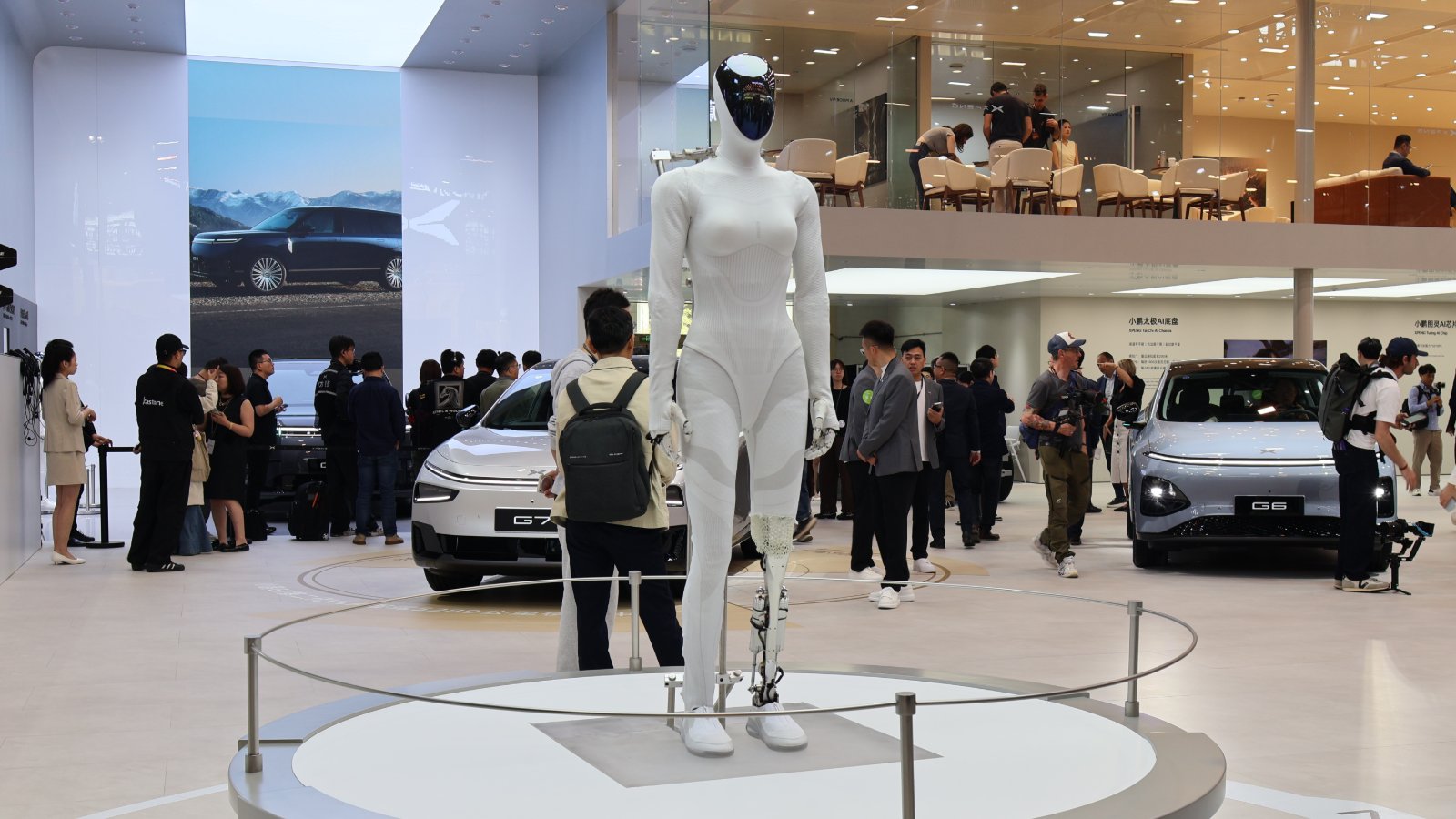
An Xpeng Iron humanoid robot on display at the April 2026 Beijing Auto Show. Credit: CnEVPost
- With a parameter scale of about 4 billion, GroundingPI beat OpenAI's GPT-6 Astra in a comprehensive evaluation across 34 public perception benchmarks.
- The model can significantly reduce the cost of manually collecting robot demonstration data.
Xpeng (NYSE: XPEV) has unveiled an embodied perception foundation model named GroundingPI, saying the overall benchmark score of its perception module surpassed OpenAI's frontier model GPT-6 Astra.
Adopting a perception-first technical route, the model ranked first in a comprehensive evaluation across 34 public perception benchmarks with a parameter scale of about 4 billion, and demonstrated higher data processing efficiency in robot simulation tasks, the EV maker said.
The model was developed in collaboration with research teams from universities including Peking University and the University of Hong Kong.
In a comparison on the same set of 34 perception benchmarks, weighted equally across 11 capability categories, GroundingPI achieved a score of 73.68, higher than the 71.54 scored by GPT-6 Astra, which OpenAI released in September this year.
In the project's name, Grounding corresponds to the core perception capability of visual localization, while PI is short for Physical Intelligence. The code and model weights have now been open-sourced.
Existing general-purpose large models are primarily designed for digital scenarios and face an adaptation gap when applied directly to physical scenarios such as autonomous driving and robotics, Xpeng said.
GroundingPI proposes that the primary prerequisite for embodied intelligence is accurately perceiving spatial positions.
Therefore, the model does not use robot data with joint action labels during the training phase, relying entirely on pure perception data without action labels to cover 11 capability categories including general detection, text recognition, and robot spatial localization.
Embodied intelligence is typically divided into a fast system (System 1) responsible for high-speed perception and action execution, and a slow system (System 2) responsible for task understanding and planning. GroundingPI aims to provide a perception-native foundation for the fast system, rather than replacing the general large model capabilities of the slow system, Xpeng said.
The research is currently at the scientific prototype stage, but its simulation results have provided validation for 2 core challenges in scaled deployment. The first is significantly reducing the cost of manually collecting robot demonstration data.
A system using GroundingPI as its visual foundation can exceed the execution success rate of comparison models using 75% of the demonstration data while using only 50% of the data, because it directly takes on the task of locating objects in traditional Vision-Language-Action (VLA) models.
The second is bringing stronger scenario generalization. In high-density simulation scenarios such as bulk material sorting and bin counting, the system maintains stable performance when dealing with changes in materials, object categories, and backgrounds, providing support for reuse across different workstations.
GroundingPI represents an important advancement for the Chinese EV maker in building its physical AI system. Xpeng has continuously increased its bets on physical AI in recent years, hoping to drive its smart driving systems, humanoid robots, and robotaxi businesses.
Earlier this year, Xpeng merged its autonomous driving center and smart cockpit center into a general intelligence center led by AI expert Liu Xianming, pooling resources to provide unified AI middle-platform foundation support for its automotive and robotics businesses.
About Author
Lei Kang
Related Posts
Nio to hold Nio IN 2026 tech day on November 25 in Guangzhou with focus on AI
Xpeng launches GX and G9L in 11 countries each across Middle East and Africa
Xpeng plans South Korea entry, appoints former Volvo exec to lead local business
Xpeng to report Q3 results on November 16 after record quarterly deliveries
Xpeng brings G9L to Hong Kong with extended-range powertrain after European launch
Xpeng monthly deliveries top 50,000 for first time in October
- Nio
- Xpeng
- Xpeng
- Xpeng
- Xpeng
- Xpeng