
Summary
CATL and BYD's combined share rises to 44.5%, while the 6 Chinese makers in the top 10 hold 56.4%. For details, please visit CnEVPost (cnev.co).
- CATL and BYD's combined share rises to 44.5%, while the 6 Chinese makers in the top 10 hold 56.4%.
- Battery usage for South Korea's 3 major suppliers falls 13.5%, with their North American volumes roughly halving.
CATL (HKEX: 3750) and BYD (HKEX: 1211) continued to gain share in the EV battery market outside China in the first 9 months of 2026, while South Korea's 3 major suppliers were weighed down by weak North American demand.
Battery usage outside China reached 426.7 GWh during the period, up 24.7% year-on-year, according to data released Wednesday by South Korean research firm SNE Research.
That outpaced global growth of 19.7%, as rising demand in Europe and Asia offset weakness in North America. The figures cover battery electric vehicles, plug-in hybrids and hybrids.
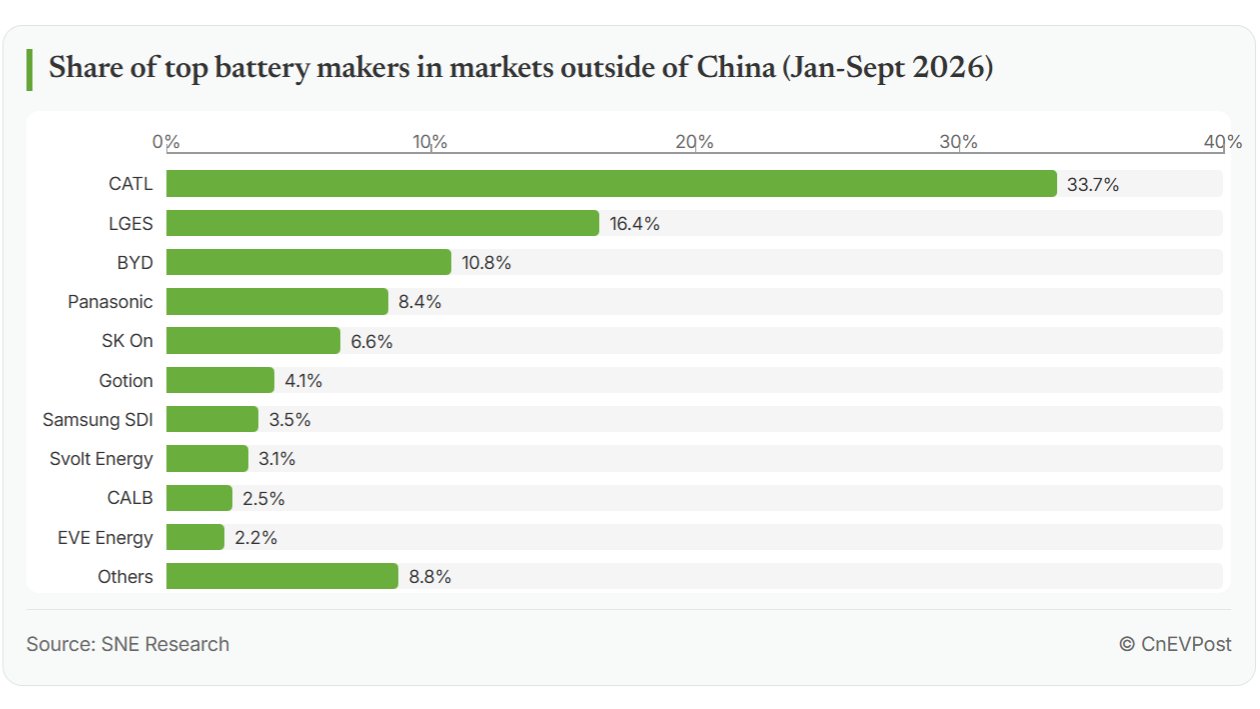
The 6 Chinese companies in the top 10 increased their combined market share to 56.4% from 43.1% a year earlier, with CATL and BYD together accounting for 44.5%.
CATL remained first with 143.7 GWh, up 46.7% year-on-year, as its market share rose to 33.7% from 28.6%.
Its battery usage in Europe grew 35.4% to 96.8 GWh, while usage in Asia excluding China more than doubled to 27.1 GWh.
CATL's Debrecen plant in Hungary began trial production on its first 2 production lines on September 22, a move SNE Research expects to strengthen its local supply capabilities for European customers.
BYD held third place with 45.9 GWh, up 66.8% year-on-year, as its market share increased to 10.8% from 8.0%.
BYD's batteries are mainly installed in its own vehicles. Its battery usage grew 68.8% in Europe, 41.0% in Asia and 135.7% in South America.
By contrast, combined battery usage for LG Energy Solution (LGES), SK On and Samsung SDI fell 13.5% to 113.0 GWh, with their market share dropping to 26.5% from 38.2%.
The decline for the 3 South Korean companies was concentrated in North America, where usage fell to 28.1 GWh from 56.1 GWh. Growth in Europe and Asia failed to offset that drop.
LGES remained second with 69.8 GWh, but its battery usage fell 4.9% and its market share declined to 16.4% from 21.5%.
SK On ranked fifth as its battery usage dropped 17.9% to 28.2 GWh and its share fell to 6.6% from 10.0%, with declines in both North America and Europe.
Samsung SDI ranked seventh with 15.0 GWh, down 34.4%, the steepest decline among the top 10 suppliers. Its market share fell to 3.5% from 6.7%.
Japan's Panasonic ranked fourth with 35.6 GWh, down 0.8%, while its share slipped to 8.4% from 10.5%. Its customer base remained heavily reliant on Tesla (NASDAQ: TSLA).
Second-tier Chinese suppliers also expanded rapidly. Gotion High-tech (SZSE: 002074) saw battery usage rise 153.8% to 17.6 GWh, overtaking Samsung SDI to rank sixth.
Svolt Energy ranked eighth as its battery usage grew 102.3% to 13.1 GWh, while CALB (HKEX: 3931) ranked ninth with growth of 88.5% to 10.6 GWh.
Eve Energy (SZSE: 300014) ranked tenth with 9.5 GWh, up 214.6%, the fastest growth among the top 10 suppliers.
Meanwhile, lithium iron phosphate (LFP) batteries increased their share of the market outside China to 27.7% from 15.8%, alongside the expansion of Chinese suppliers.
SNE Research said growing adoption of LFP batteries in entry-level models in Europe was making price competitiveness a key consideration for automakers selecting battery suppliers.
The research firm said North American EV demand had weakened following the end of tax credits, prompting South Korean suppliers to convert some production lines to batteries for energy storage systems (ESS) to tap demand beyond vehicles.
In Europe, Chinese suppliers are ramping up production at local plants. SNE Research expects local production capabilities, price competitiveness and supply chain traceability to shape their market positions.
Those traceability preparations include meeting Battery Passport requirements set to take effect in February 2027, adding a compliance dimension to competition among suppliers.
About Author
Phate Zhang
Related Posts
CATL, Octopus Energy and Ampace partner to explore European home energy storage
BYD's Denza N9 to add all-electric version with 5- and 6-seat layouts
BYD teases new model for Guangzhou Auto Show, with next-gen Han expected
CATL expands eVTOL partnerships with Blue Vector deal
Global EV battery market share in January-September 2026: CATL 39.1%, BYD 15.2%
BYD sales rise 11% to year-to-date high in October as BEVs top 300,000 for first time
- CATL
- BYD
- BYD
- CATL
- Battery
- BYD