
Summary
In the first nine months of 2026, Chinese manufacturers secured more than half of the global electric vehicle (EV) battery market. According to the latest data from the South Korean research firm SNE Research, one out of every two power batteries installed in…
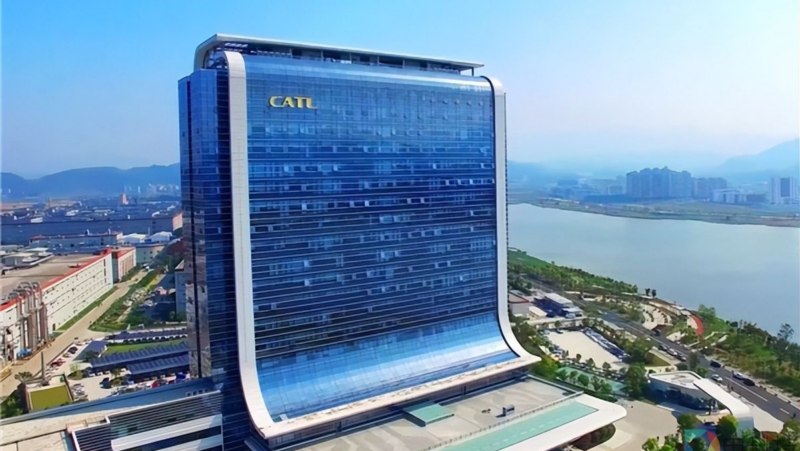
In the first nine months of 2026, Chinese manufacturers secured more than half of the global electric vehicle (EV) battery market. According to the latest data from the South Korean research firm SNE Research, one out of every two power batteries installed in EVs outside of China now originates from a Chinese supplier.
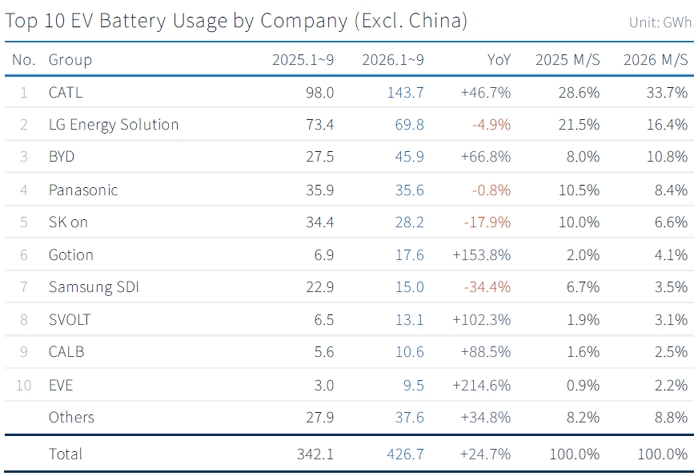
During the January-September period, the total overseas power battery installation volume from Chinese manufacturers reached 426.7 GWh, marking a 24.7% year-over-year increase – outpacing the 19.7% growth rate of the global market. Six major Chinese battery companies – CATL, BYD, Gotion High-Tech, Svolt, CALB, and Eve Energy – collectively captured a 56.4% share of this overseas market, an increase of over 13 percentage points compared to the same period last year.
Industry leaders
CATL remains the top supplier in the overseas market. In the first three quarters, its non-Chinese market installations reached 143.7 GWh, a 46.7% increase, boosting its overseas market share to 33.7%. SNE Research noted that the commencement of trial production at CATL’s Hungarian plant is expected to further solidify its European supply chain foundation.
BYD secured the third position in the overseas market with 45.9 GWh of installations, a 66.8% surge, bringing its market share to 10.8%. Unlike CATL, BYD’s battery growth is closely tied to its own vehicle exports, which have doubled compared to the previous year.
While industry giants continue to lead, the growth of second-tier Chinese manufacturers has been particularly aggressive. Eve Energy led the pack among the top ten with a 214.6% growth rate (9.5 GWh), followed by Gotion High-Tech at 153.8% (17.6 GWh), Svolt at 102.3% (13.1 GWh), and CALB at 88.5% (10.6 GWh).
Contrasting trends: Korean and Japanese competitors
In contrast, the three major South Korean battery manufacturers – LG Energy Solution, SK On, and Samsung SDI – saw their combined share in the non-Chinese market drop from 38.2% to 26.5%, with total installations falling 13.5% to 113 GWh. This decline was largely attributed to a sharp contraction in the North American market.
Meanwhile, Japan’s Panasonic, which remains heavily reliant on Tesla, saw its market share dip to 8.4% with 35.6 GWh of installations.

Liu Miao
Writer
Liu Miao covers NEVs and batteries at CNC to contribute to the energy transition, in spare time he loves driving his EV around.


