
Summary
Seven Chinese companies ranked among the top 10, with a combined 72.4% share of the global EV battery market. For details, please visit CnEVPost (cnev.co).
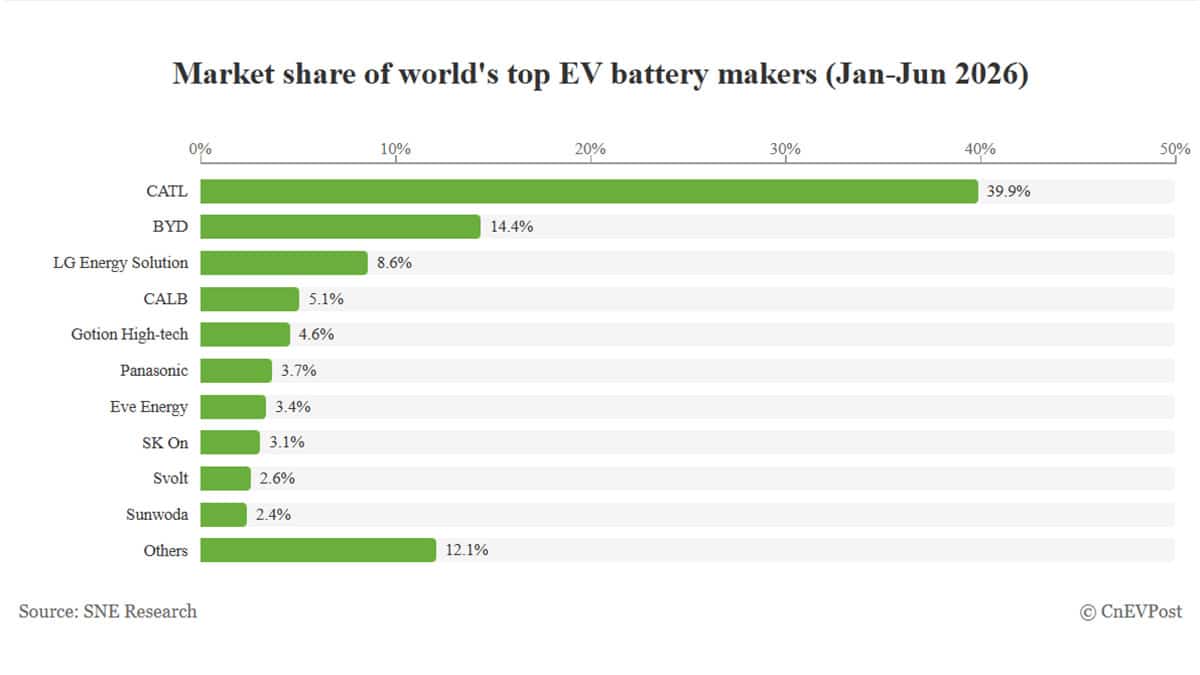
- Seven Chinese companies ranked among the top 10, with a combined 72.4% share of the global EV battery market.
- CATL and BYD together accounted for 54.3% of the market.
CATL (HKEX: 3750) and BYD (HKEX: 1211) continued to dominate the global electric vehicle (EV) battery market in the first half of 2026, though their performances diverged.
Global EV battery usage reached 608.5 GWh in the first half of 2026, up 20.0% year-on-year, according to data released Wednesday by South Korean market research firm SNE Research.
CATL recorded battery installations of 242.7 GWh during the period, up 25.3% year-on-year.
The Chinese battery giant held a 39.9% share of the global market, up from 38.2% a year earlier, though slightly below the 40.2% recorded in the January-May period.
Second-ranked BYD delivered a muted performance in the first half, with battery installations reaching 87.7 GWh, up just 1.6% year-on-year.
BYD's global market share fell to 14.4% from 17.0% a year earlier, a decline of 2.6 percentage points.
The 2 Chinese giants had a combined market share of 54.3%, accounting for more than half of the global EV battery market.
South Korea's LG Energy Solution (LGES) ranked third globally with battery installations of 52.6 GWh, up 8.4% year-on-year.
LGES supplies customers including Tesla (NASDAQ: TSLA), Hyundai Motor Group, GM and Volkswagen. However, its growth lagged the broader market, causing its share to fall to 8.6% from 9.6% a year earlier.
China's CALB (HKEX: 3931) ranked fourth with installations of 31.2 GWh, up 39.5% year-on-year. Its market share rose to 5.1% from 4.4%.
China's Gotion High-tech (SZSE: 002074) followed in fifth place, with installations of 28.0 GWh, up 43.3% year-on-year. Its share increased to 4.6% from 3.9% a year earlier.
Japan's Panasonic ranked sixth with 22.7 GWh of installations, up 10.2% year-on-year.
The company benefited from Tesla's sales in North America, but its growth remained below the market average, reducing its share to 3.7% from 4.1%.
China's Eve Energy (SZSE: 300014) ranked seventh with installations of 20.9 GWh, surging 51.7% year-on-year. Its market share rose to 3.4%.
South Korea's SK On was the only company among the top 10 to record a decline in installations. Its volume fell 6.7% year-on-year to 19.0 GWh, while its share contracted to 3.1% from 4.0%.
SNE Research said adjustments to EV sales and production plans by some customers in North America and Europe had limited the recovery in SK On's battery installations.
China's Svolt Energy and Sunwoda (SZSE: 300207) ranked ninth and 10th, respectively, with installations of 15.7 GWh and 14.5 GWh, up 40.9% and 13.7% year-on-year. Their respective market shares were 2.6% and 2.4%.
A total of 7 Chinese companies ranked among the global top 10, with a combined market share of 72.4%, up 1.5 percentage points from a year earlier.
Outside China, EV battery installations reached 269.0 GWh in the first half, up 26.3% year-on-year, outpacing the overall global market.
CATL also ranked first in markets outside China, with installations of 90.5 GWh, up 41.7% year-on-year. Its share rose to 33.6% from 30.0%.
BYD ranked third outside China, with installations of 28.2 GWh, up 67.9% year-on-year. Its market share increased by 2.6 percentage points to 10.5% from 7.9%.
Smaller Chinese battery makers posted even steeper growth overseas.
Gotion's installations outside China reached 9.9 GWh, up 141.5% year-on-year. Svolt recorded 8.4 GWh, up 106.0%; CALB posted 6.3 GWh, up 80.5%; and Eve Energy reached 5.1 GWh, up 171.5%.
Samsung SDI recorded the steepest decline among the top 10 suppliers. Its installations in non-China markets fell 29.0% year-on-year to 10.5 GWh, while its market share dropped to 3.9% from 7.0%.
SNE Research said Samsung SDI continued to supply BMW, Audi and Rivian (NASDAQ: RIVN), but weak Rivian sales and softer demand for older models from its major European customers directly weighed on its battery installations.
About Author
Lei Kang
Related Posts
CALB responds to 'banana battery' fallout with quality overhaul
BYD Yangwang launches 4-seat version of flagship U8L SUV at about $215,000
BYD's first Brazil-built plug-in hybrid goes on sale, running on gasoline, ethanol or electricity
China's sodium-ion push widens with first electric mining truck delivery
BYD Fang Cheng Bao tops 500,000 cumulative sales in under 3 years
Global ESS battery market share in H1 2026: CATL at 27.1% as non-China markets overtake China
- Battery
- BYD
- BYD
- Battery
- BYD
- Battery