
Summary
A 60 kWh battery filled overnight in your garage costs about ten dollars. The sa…
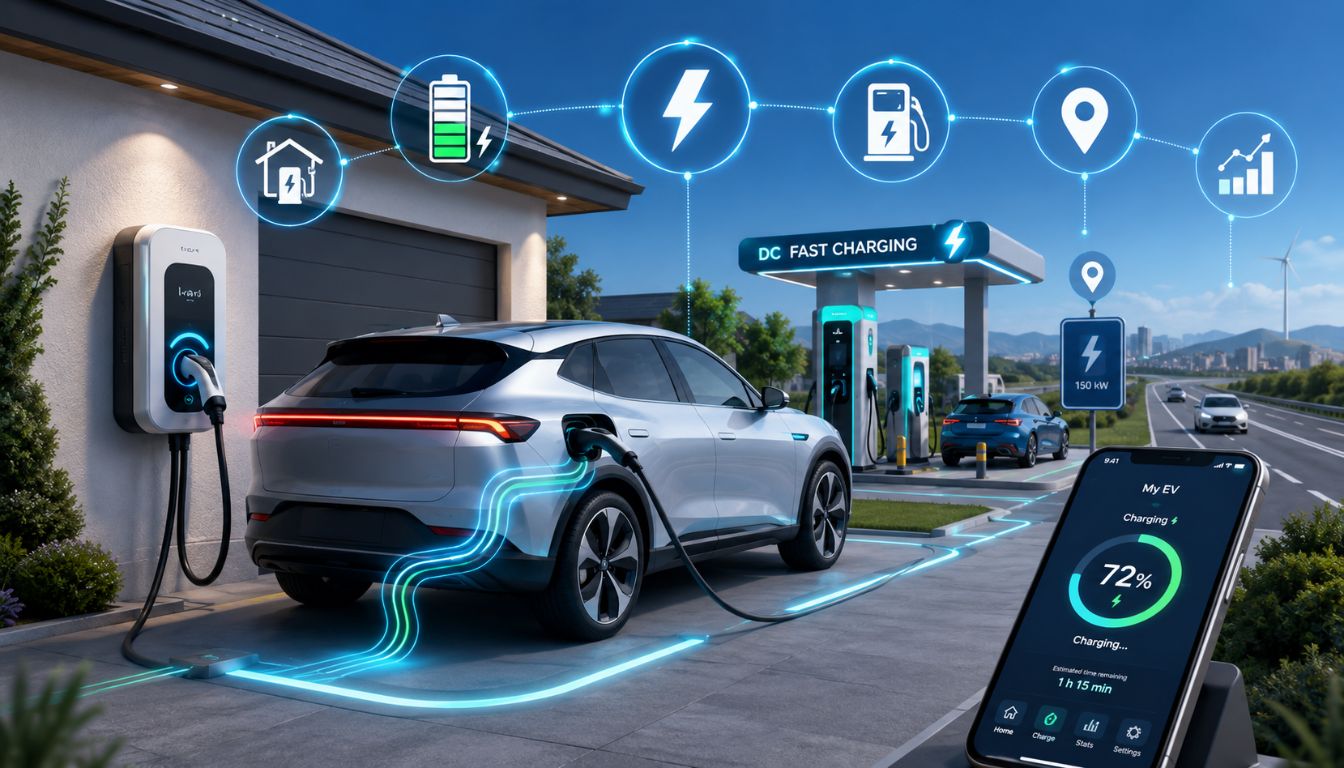
A 60 kWh battery filled overnight in your garage costs about ten dollars. The same charge at a DC fast charger during peak hours can run twenty-five to thirty-three. The gap between home and public power is roughly two to four times per kWh, and it has nothing to do with which network's logo is on the pedestal. It is set by where and when you plug in.
Here is the ledger first, then how each line is set.
The ledger: what 60 kWh costs in each setting
| Setting | Per kWh | A 60 kWh fill | Per 100 miles* |
|---|---|---|---|
| Home, off-peak TOU | $0.10–0.15 | $6–9 | $2–3 |
| Home, standard rate | $0.15–0.20 | $9–12 | $3–4 |
| Public Level 2 | $0.20–0.40 | $12–24 | $4–8 |
| DC fast charging | $0.35–0.55 | $21–33 | $7–11 |
*At roughly 30 kWh per 100 miles. Rates vary by state and utility; treat the table as magnitudes, not quotes. The ratio is what holds: fast charging routinely costs three times a home overnight rate.
Home charging: one install fee, then pennies per mile
About four in five EV charging sessions in the US happen at home. A Level 2 setup (a 240V circuit, like a dryer outlet) adds 15–30 miles of range per hour, enough to refill any EV overnight. The hardware runs $150–600, an electrician's install $300–1,000, and an older panel that needs upgrading can add $1,500–3,000.
Two offsets shrink that bill: the federal 30C credit covers up to $1,000 of equipment and installation but expires June 30, 2026, and many utilities rebate another $100–500. After that, every mile costs you three or four cents in electricity instead of ten-plus at a public fast charger. Most households that charge daily recover the install within one to two years.
Public charging: the owner sets the price, and the network adds a fee
The thing that surprises new EV drivers is that networks like ChargePoint do not set prices. The hotel, grocery store, or city that owns the station does, which is why two ChargePoint stations a mile apart can charge wildly different rates. Check the price in the app before every session.
On top of the owner's rate, networks now add their own fees. ChargePoint introduced a per-session Service Fee in March 2026: $0.25 on Level 2 and $0.49 on DC fast for account holders, higher for guest credit-card sessions, waived on free stations and workplace or fleet charging. Session fees, minimum fees, and idle fees stack onto the per-kWh rate, so the sticker price in the app is the only number that matters.
Road trips and idle fees: when the premium is worth it
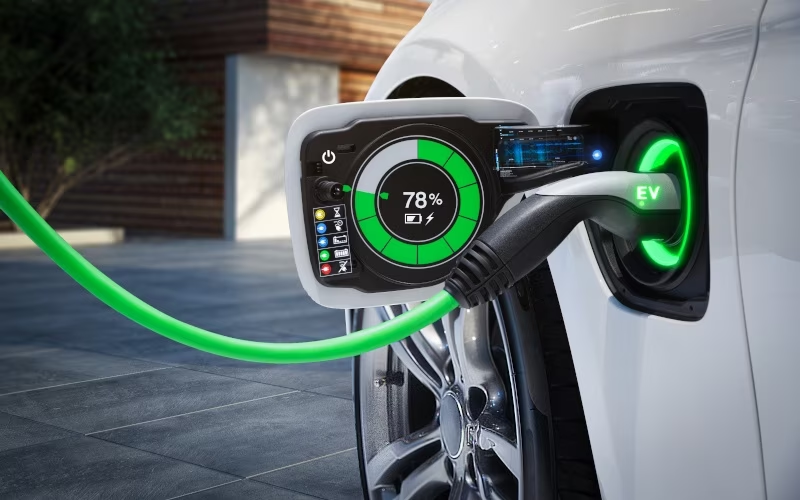
DC fast charging at $0.35–0.55 per kWh is the most expensive way to fuel an EV, and on a road trip it is still worth it. What you are buying is speed: a 150–350 kW charger takes a battery from 10% to 80% in twenty to forty-five minutes.
Two habits keep the bill honest. First, charge to 80% and leave. The charge curve tapers hard past that point, so the last fifth of the battery takes as long as the first four-fifths. Second, unplug when done. Idle fees (a per-minute charge once your session ends) are now standard on busy corridors, and they exist precisely because lingering cars cost other drivers time.
Which setup fits which driver
If you have a driveway or garage, install Level 2 before the 30C credit expires and set the car to charge overnight; your per-mile cost drops to a quarter of what public fast charging takes. If you cannot charge at home, build your routine around public Level 2 at workplaces and errands, and treat DC fast as the road-trip tool it is.
Either way, the rule is the same: the electricity is identical, you are paying for the hour and the convenience.
Sources: Axis Intelligence ChargePoint 2026 guide; EV Direction 2026 charging guide; DOE AFDC; IRS Form 8911. Retrieved 2026-09-23. Rates vary by state, utility, and station owner; check the app price before each session.