
Summary
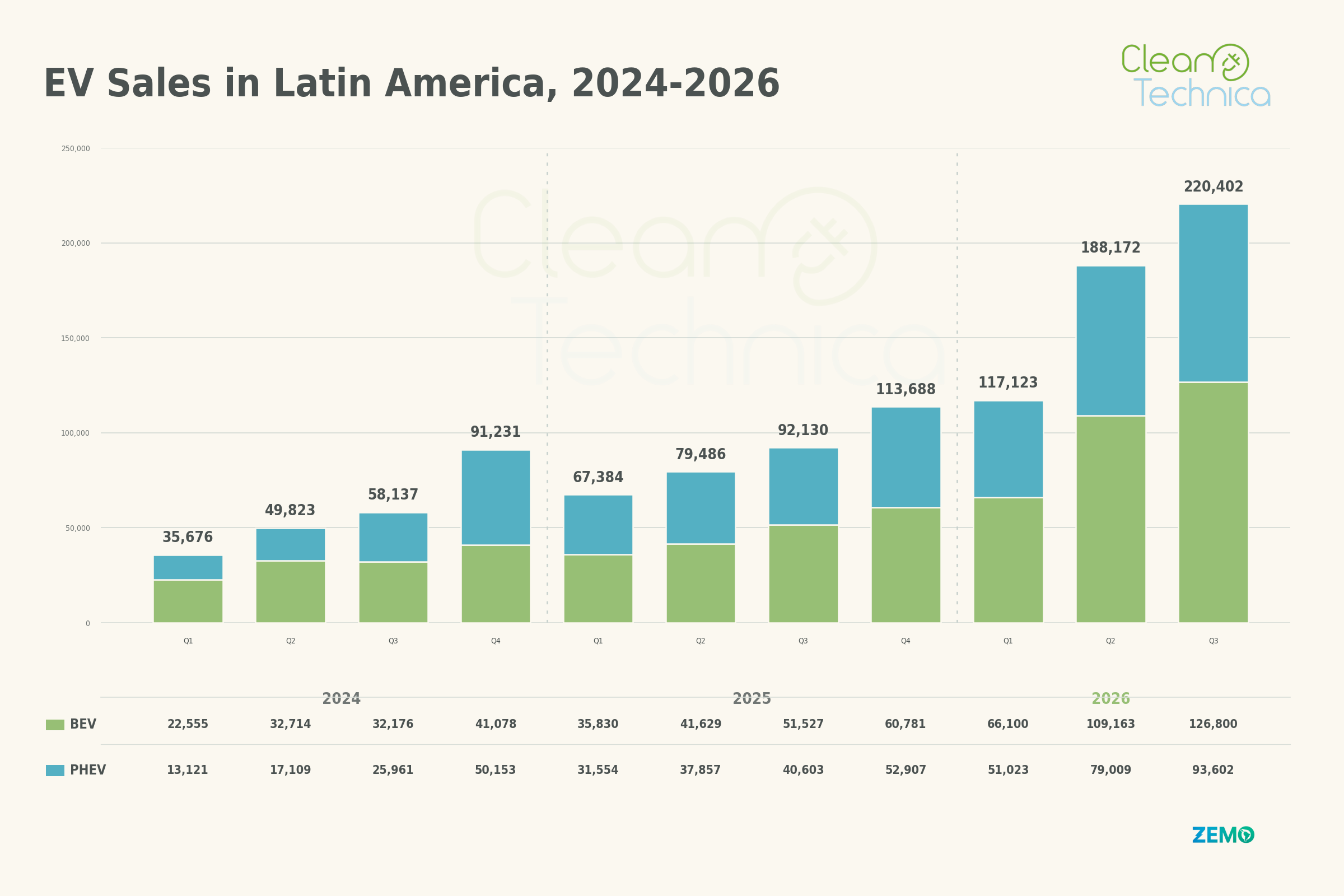
Through 2026, EVs have gained significant momentum all over the world (safe for the US), and Latin America has been no exception. Sales grew by almost 140% in the third quarter, and clock in at a very healthy 120% growth through 2026, bringing the yearly tota…
Through 2026, EVs have gained significant momentum all over the world (safe for the US), and Latin America has been no exception. Sales grew by almost 140% in the third quarter, and clock in at a very healthy 120% growth through 2026, bringing the yearly total to more than half a million units.
If this trend continues, it’s all but certain we will surpass 700,000 units by the end of the year, and perhaps even get to 800,000.
Another interesting bit of trivia is that sales reached 220,000 units in the third quarter, not too far behind the USA’s 266,000. In theory, this means it should be possible for LatAm to surpass total US EV sales as early as Q1 2027 … though, I would be much happier if the USA’s market starts growing strongly again and thus Latin America cannot get ahead.
Now, to be fair, the US is much more BEV-heavy (242,000 units sold, vs 127,000 in LatAm), whereas Latin America prefers PHEVs to a higher degree (93,000 units sold vs 44,000 in the US), but, still, these are impressive results for a region overall much poorer than the US, and with a vehicle market around a third of the size. For over a decade, it was the richest countries in the world that led EV adoption, but — as many of us predicted on this very site — that has now changed.
Let’s look at the numbers!
Market overview
As mentioned earlier, total EV sales reached 220,000 units, surpassing for the first time the 200,000 mark and growing a healthy 140% YoY, and a strong 17% from Q2. BEVs grew faster than PHEVs (146% vs 130%), and thus now represent 57.5% of all EV sales in the region, slightly below the 58% result for Q2.
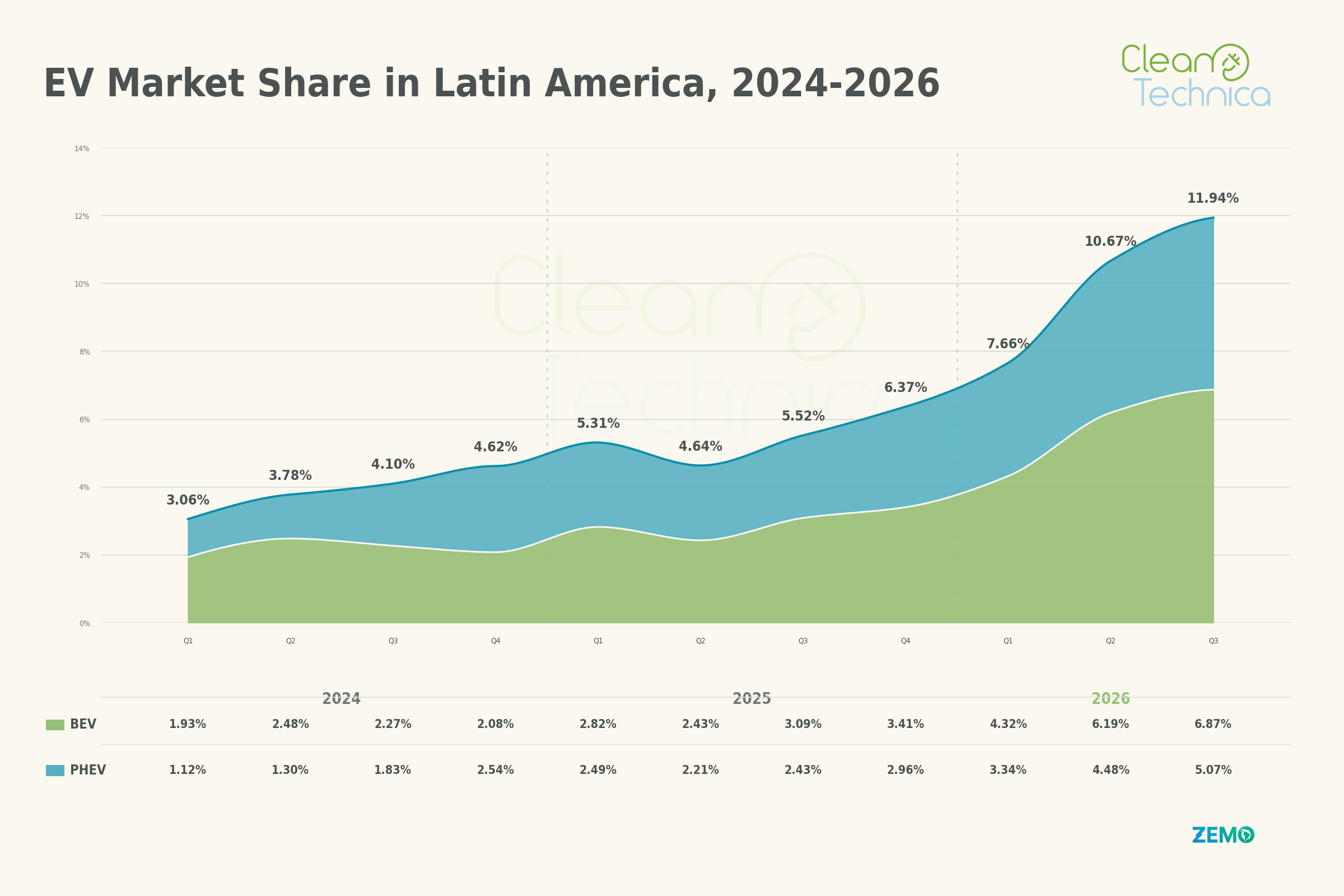
Market share grew to 12%, up from 10.7% in Q2 and 5.5% in Q3 last year, a pretty strong result. This brought market share above 10% through 2026, 5.9% BEV and 4.3% PHEV.
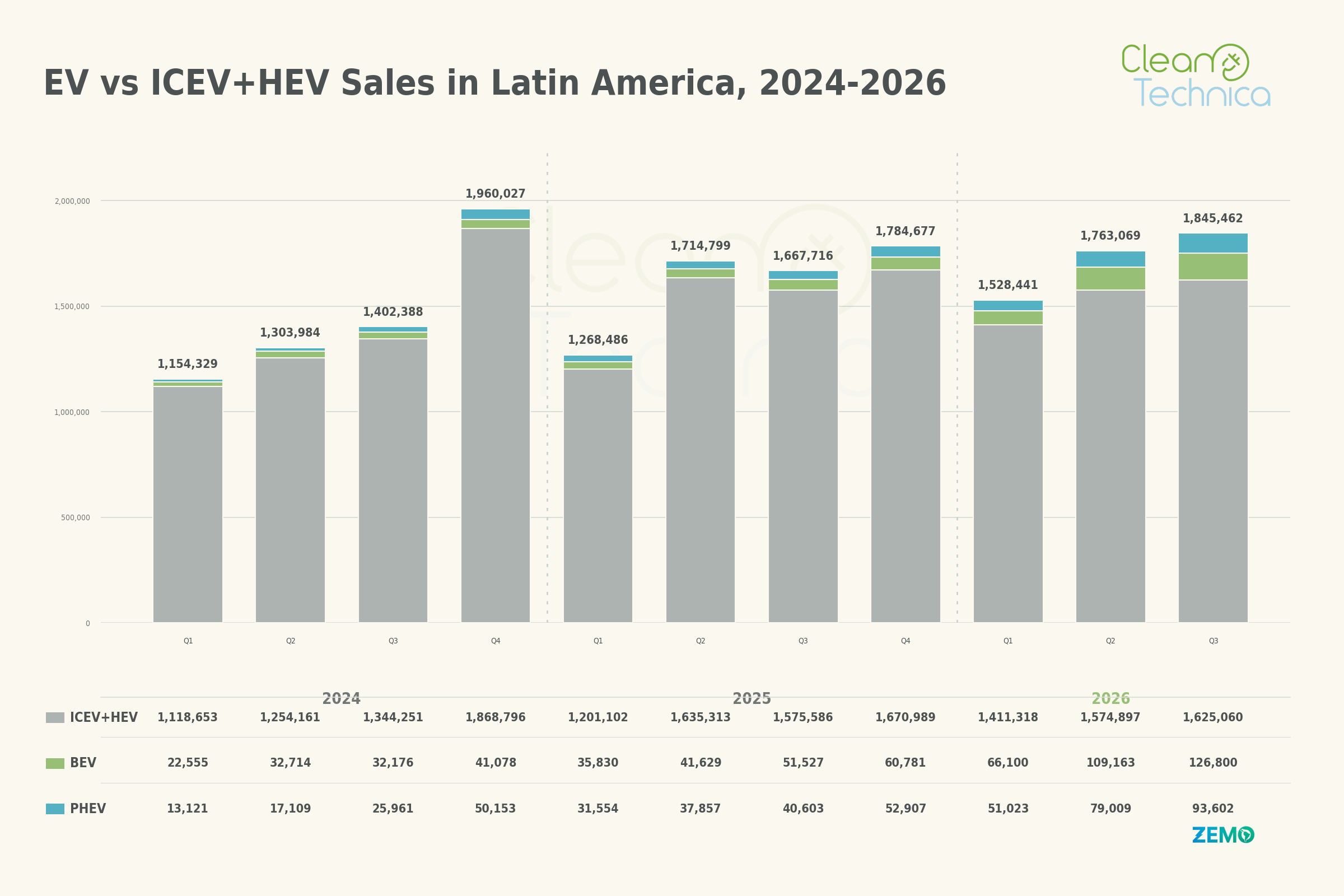
Latin America’s overall vehicle market is growing at rates of around 10% annually, but thanks to strong EV growth, combustion-based powertrains (HEV, MHEV and ICEV) are stagnant: they fell by 3.7% last quarter, and barely grew by 3.1% this one, meaning it’s very likely that we’re reaching “Peak Combustion” in Latin America and the market will only go down from 2027 onwards.
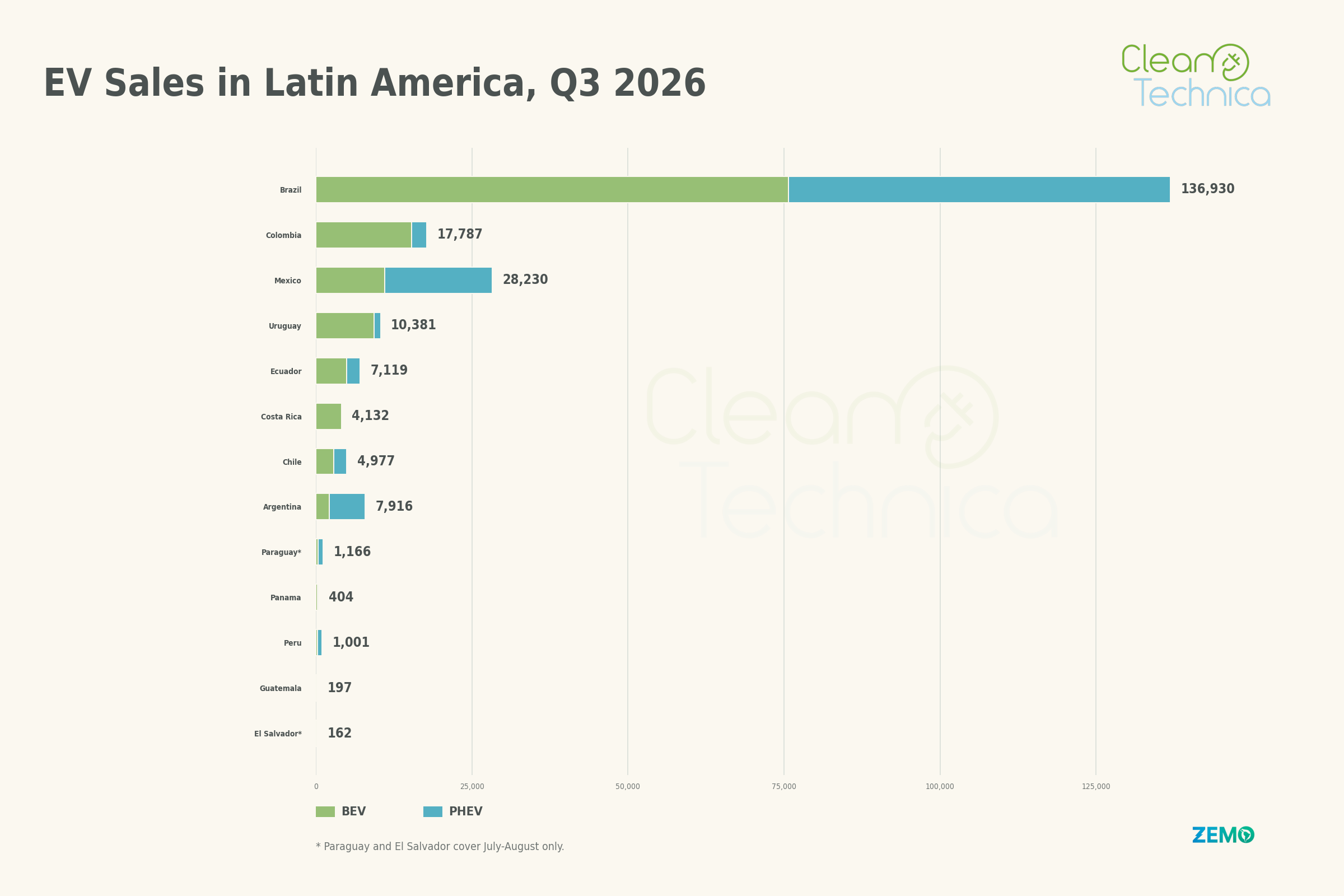
Sales wise, we have a pretty stable list, with Brazil being the unsurprising winner, followed by Mexico and Colombia, just as in Q2. Uruguay follows, but then we have a new rising star: Ecuador, which nearly reached 5,000 BEVs sold last quarter! Costa Rica, Chile, and Argentina close the top 8 and make up all the countries with over 1.000 quarterly BEV sales.
PHEV sales are much more varied, though. Brazil, of course, leads again, but following come Mexico and Argentina, with Colombia in 4th place and Ecuador in 5th.
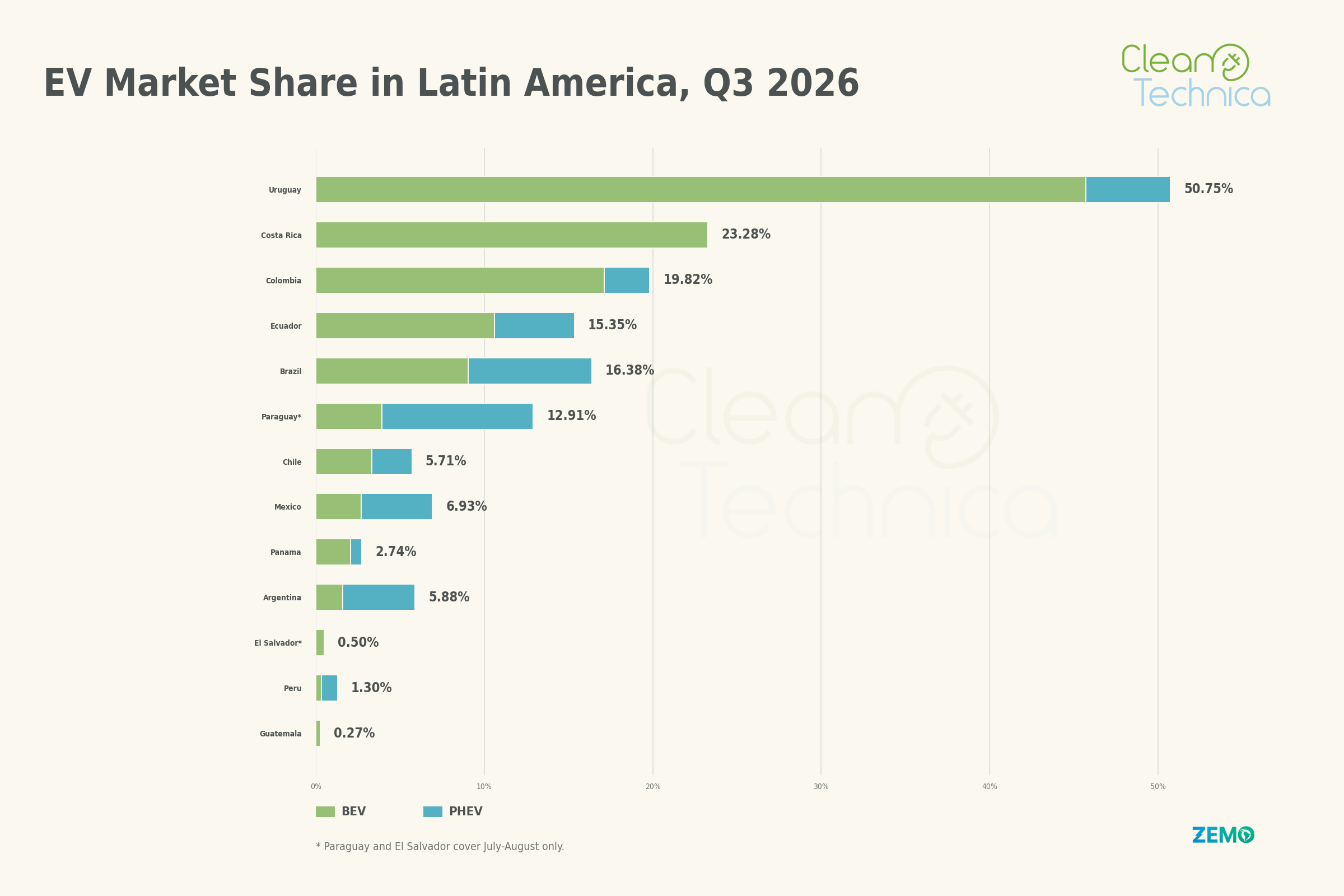
Market share: again, we have a pretty constant list, with the first 8 positions unchanged. Uruguay, unsurprisingly, leads the region with a very strong 50.7% EV market share (45.7% BEV), followed by Costa Rica, Colombia, Ecuador, and Brazil. Notable mention to Paraguay, the sixth country in our region to reach 10% EV market share through a quarter, but in this case thanks to PHEVs.
Drivers of growth
This has been an eventful year due to Donald’s dubious defense decisions, but even as high oil prices have been driving massive EV adoption and/or massive ICEV crashes all over the world, I feel the situation in Latin America isn’t as clear cut.
In the US and Europe, fuel prices have gone up by around 40–50%, at least in the case of gasoline. Now, prices have gone up similarly in some countries in Latin America, including Panama, Paraguay and Perú, but in many others, like Brazil, Colombia and Mexico, it has barely moved, either because of significant subsidies — direct or indirect — to maintain prices, or because it was already expensive before the war and the government did not make any adjustments to its price.
One would think that the countries most affected by high fuel prices would be at the forefront of the EV transition, but no: the largest increases in EV sales only partially track gasoline prices. For example: Panama and Perú are still lagging behind the region despite having the highest increase in the region (>50% in both cases), whereas Colombia and Brazil are sprinting ahead despite relatively stable fuel prices. What gives?
The answer, I believe, is linked to EV prices and how they compare with their ICEV competition. Yes, I know the TCO is a very important metric, but evidence in our markets point to the sticker price being the main driver of adoption. The cases of Brazil and Colombia on one hand, and Peru and Panama on the other, exemplify this very well:
Brazil and Colombia have had pretty stable fuel prices, up around 10% or less since the war started, yet both have booming markets, up 160% and 190%, respectively, with EV market share getting close to 20%. Meanwhile, Panama and Peru have seen gasoline prices spike over 50% from their pre-war costs, yet the former only showed a meager 57% growth in September, and the latter, though clocking in at a more impressive 270% YoY, remains at a disappointing 1.3% market share.
The main difference has to do with the nature of the market. In Brazil and Colombia, combustion vehicles are relatively expensive — in no small part due to tariffs to protect local industry — and EVs have effectively reached price parity with their combustion counterparts.
Meanwhile, in Panama and Per,u EVs are just as cheap if not cheaper than in Brazil or Colombia, but combustion cars are significantly cheaper, with some entry-level models at or below USD$10.,00. This makes customers hesitant to try the new technologies by the simple logic that even if the EV will save a lot of money in the long run, $6,000 will buy a lot of gas.
And in Peru, this is particularly relevant insofar as gas-mobiles from Chinese brands are very popular. Changan, Jetour, Geely, and JAC together account for 20% of the Peruvian market largely thanks to their hyper-affordable combustion cars, and since the Chinese gas-mobile market is collapsing, it’s likely these brands would rather keep it like this for a few more months so they can move some of the inventory they won’t be able to sell at home before betting it all on EVs.
In general, this tracks for most markets, where EV prices compared to traditional combustion cars are probably the most relevant factor to keep track of. And of course, fuel prices do have an influence, but it seems it’s rather limited compared to, for example, what we’re seeing in Europe.
But the lessons are clear: Want to improve EV sales? Either make them cheaper, or make gas-mobiles more expensive.
Final thoughts
At the beginning of this year, I was hopeful we would see 10% market share in the fourth quarter, normally the highest in the year. We went past that in Q2, and at 12% we’re sitting far beyond what I considered feasible only 10 months ago.
Yet there’s still a long path ahead. Aside from the 5 leading markets, we’re yet to see a country getting consistent BEV market share above 5%, and several large markets — Chile, Argentina, and Mexico — are still lagging. PHEVs have raised the bar in several countries, Paraguay most important of all, but we would rather see more BEVs.
This is not to be overtly pessimistic. The results so far are great, much better than we would’ve expected even a year ago. But as things improve the bar rises, and I’m now waiting to see the moment when we will see 20% market share (Q3 2027?) or when e-truck sales will start to ramp up (2027? 2028?).
What do you guys think?
CleanTechnica's Comment Policy
Share this story!
- Share on LinkedIn (Opens in new window) LinkedIn
- Share on WhatsApp (Opens in new window) WhatsApp
- Share on Facebook (Opens in new window) Facebook
- Share on Bluesky (Opens in new window) Bluesky
- Email a link to a friend (Opens in new window) Email
- Share on Reddit (Opens in new window) Reddit