
Summary
The milestone comes just 6 months after the 100 million mark was reached on February 6, showing accelerating usage. For details, please visit CnEVPost (cnev.co).
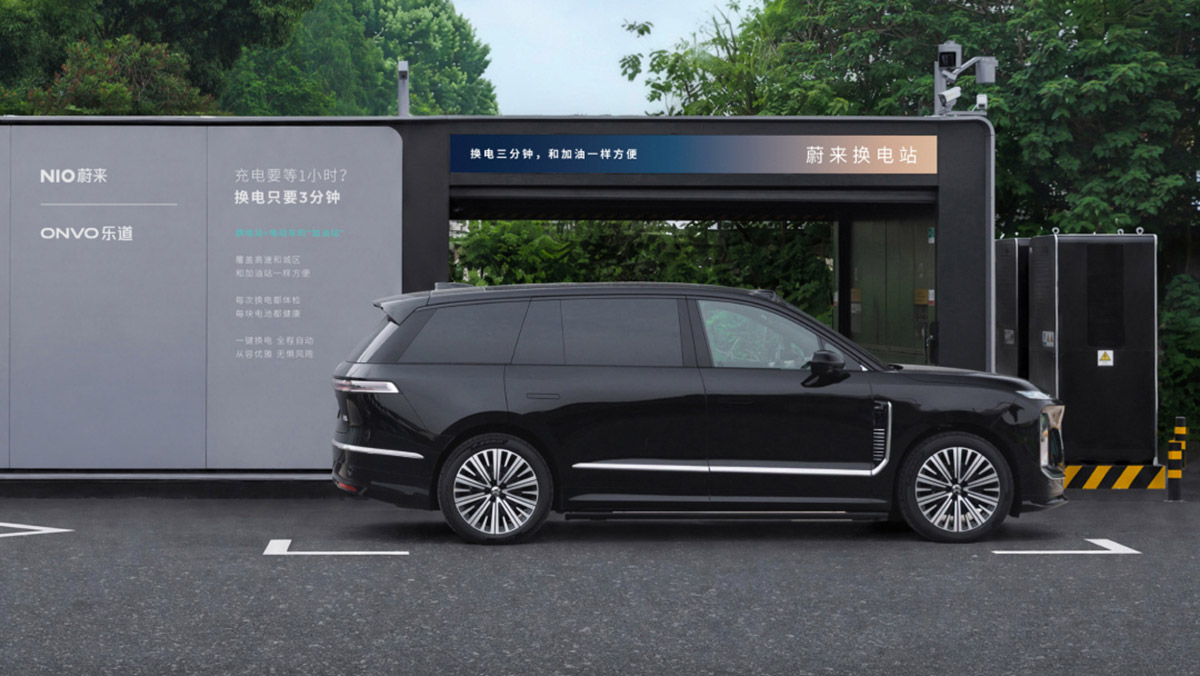
A Nio battery swap station. Credit: Nio
- The milestone comes just 6 months after the 100 million mark was reached on February 6, showing accelerating usage.
- The 4,000th site is the first fifth-generation swap station and is open to Firefly for the first time.
Nio Inc (NYSE: NIO) has surpassed 120 million cumulative battery swap services, the Chinese electric vehicle (EV) maker announced on Friday. The milestone was reached at 8:09:16 am Beijing time.
Nio's charging map shows it currently has 4,006 battery swap stations in China, meaning 7 new sites were added today.
A screenshot of the Nio charging map.
The company will hold a ceremony later today in Quanzhou, Fujian province, to mark the launch of its 4,000th swap station in China, which is also its first fifth-generation station.
Nio founder, chairman and CEO William Li said in a Weibo post earlier today that he was flying from Shanghai Hongqiao Airport to Quanzhou to attend the launch ceremony for the milestone station.
The fifth-generation station uses a rebuilt underlying architecture that can accommodate a wider range of vehicle wheelbases.
That allows the flagship SUV (sport utility vehicle) ES9, which is 5.3 meters long, and the Firefly EV, which is 4.003 meters long, to share the same swap mechanism.
It means Nio's swap network will serve users of all three brands -- Nio, Onvo and Firefly -- for the first time. The compact Firefly was previously unable to use existing stations because its wheelbase was too short.
The growth in swap usage is speeding up. Nio reached its 100 millionth battery swap service on February 6, which was 2,819 days after its first service in May 2018.
It took the company just six months to add the latest 20 million.
Nio Inc users have consumed a cumulative 6.35 billion kWh through swaps, equivalent to a year of electricity use by 3.17 million households, according to data the company shared on Friday.
Compared with charging, swapping has saved users 99.91 million hours, or an average of 83 hours per user.
Compared with gasoline vehicles, swapping has saved users a cumulative 31.2 billion yuan ($4.6 billion), or an average of 26,000 yuan per user.
Coverage density is also improving. Nio said 80.1% of its users have at least one battery swap station within three kilometers of where they live or work.
Its 1,049 highway swap stations connect 550 cities, forming a highway swap network covering 16 major city clusters in China.
Nio has maintained its target of adding more than 1,000 swap stations in 2026. That goal increasingly depends on partnerships, as the company slowed its own construction pace over the past two years to control capital spending.
Nio added 679 swap stations in 2024 and 681 in 2025, according to data compiled by CnEVPost.
In June, Nio Power signed an agreement with Anhui's Zhongan Energy to jointly build 500 swap stations within one year.
($1 = 6.7904 yuan)
About Author
Phate Zhang
Related Posts
Basketball legend Yao Ming takes delivery of Nio ES9 after 2 months
Nio, Zhongan deliver 90 swap stations as partnership goes national
Nio ES8 leads China EV owner loyalty, with buyers comparing just 1 rival on average, survey finds
Nio's flagship ES9 SUV set to reach 20,000th delivery this week
Nio's first fifth-gen swap station to go live on August 7, supporting Firefly for first time
Nio brand's July average transaction price hits $64,010 as ES8, ES9 anchor premium push
- Nio
- Nio
- Nio
- Nio
- Nio
- Nio