
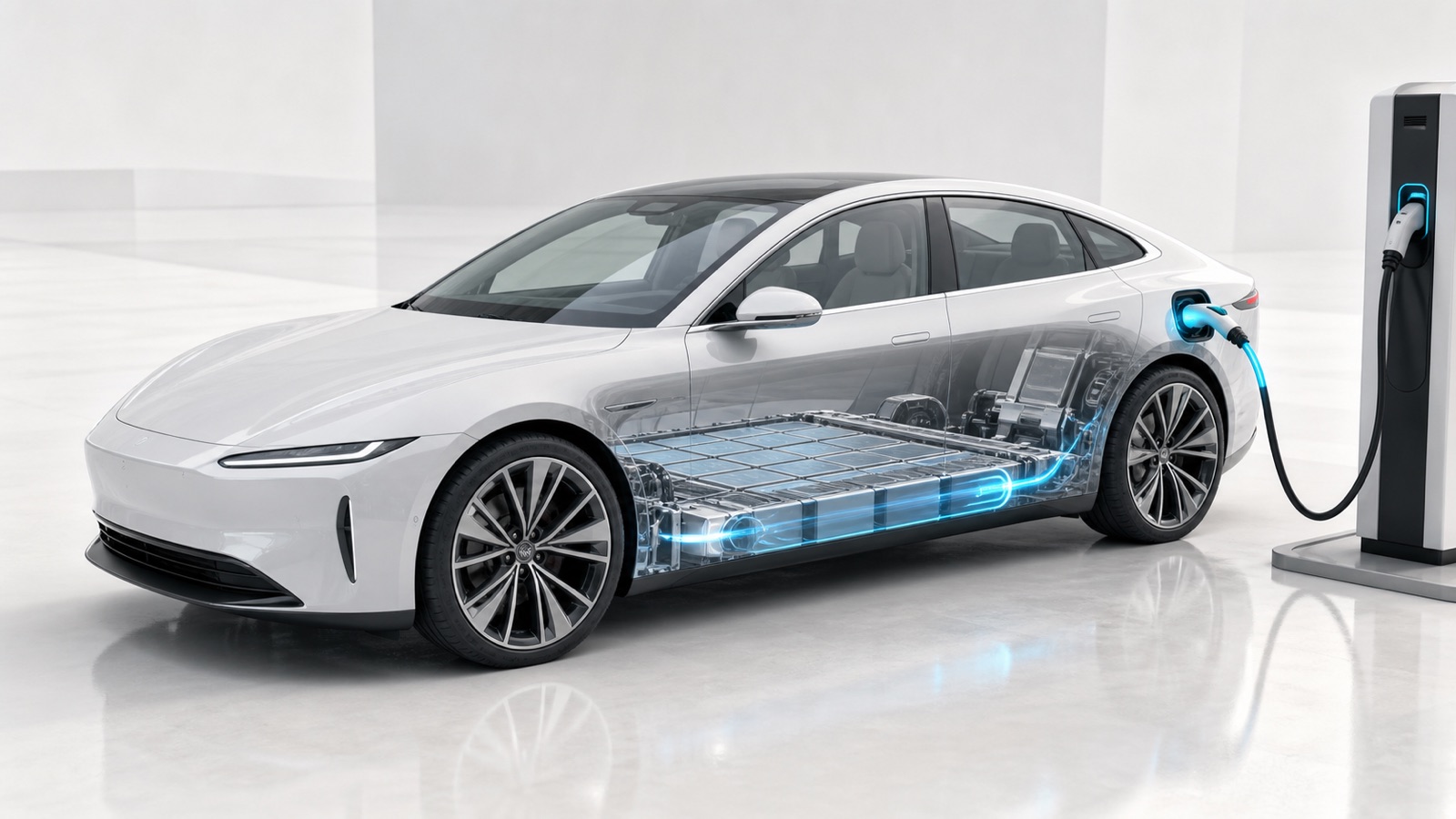
Summary
A practical guide to battery size, CLTC range, 800-volt platforms and fast-charging claims, starting with what each upgrade is actually worth.
Suppose one version of an EV has a 60 kWh battery and costs RMB 150,000. The long-range model has 75 kWh and costs RMB 165,000. The salesperson points to another hundred-plus kilometres of rated range, an 800-volt platform and 5C charging. All of those claims may be accurate. They still do not settle whether the extra RMB 15,000 is money well spent.
Three calculations will get you much closer. Work out what the additional battery capacity costs, how much of the CLTC range is likely to survive a motorway journey, and how long a 10-to-80-percent charging stop actually takes. Once those numbers are clear, most of the marketing language becomes easier to sort.
Start with the price of the battery
One kilowatt-hour is one unit of electricity. A 75 kWh pack stores 15 kWh more than a 60 kWh pack, a 25 percent increase on paper. The larger pack also adds weight, so it will not deliver a full 25 percent more range in normal driving.
Carmakers do not disclose their battery supply contracts, but industry averages give us a useful scale. BloombergNEF put the average lithium-ion pack price in China at about $84 per kWh in its 2025 survey. [C9] Using a rough exchange rate of RMB 7.2 to the dollar, the extra 15 kWh represents about RMB 9,070 of pack cost.
That accounts for a large share of the RMB 15,000 price difference in our example.
| BloombergNEF 2025 price basis | 60 kWh pack | 75 kWh pack | Cost of the extra 15 kWh |
|---|---|---|---|
| China average, $84/kWh | About RMB 36,300 | About RMB 45,400 | About RMB 9,070 |
| LFP average, $81/kWh | About RMB 35,000 | About RMB 43,700 | About RMB 8,750 |
| NMC average, $128/kWh | About RMB 55,300 | About RMB 69,100 | About RMB 13,800 |
These figures are a benchmark, not a quotation for a particular car. A long-range trim may also include a different motor, larger wheels, upgraded seats or more driver-assistance hardware. Put the two official equipment lists side by side and mark everything that changes. If the larger battery accounts for roughly RMB 9,000 of a RMB 15,000 upgrade, the remaining equipment needs to justify the other RMB 6,000.
Battery chemistry matters more than the badge on the cell
Names such as CATL, BYD and CALB identify the cell or battery-system supplier. Manufacturing scale and production history are worth knowing. Once the pack is installed, however, the carmaker designs or specifies much of the cooling, impact protection and control software. The vehicle brand also writes the warranty.
Lithium iron phosphate, usually shortened to LFP, is common in less expensive trims. Its strengths include lower cost, long cycle life and good thermal stability. Nickel manganese cobalt, or NMC, can deliver a lighter and more compact pack at a given capacity, and it often performs well in cold weather and at high power. BloombergNEF's 2025 averages were about $81 per kWh for LFP and $128 per kWh for NMC. [C9]
That price gap helps explain why LFP is so common in entry versions. It cannot tell you the exact saving on one model because the carmaker's contract price is private.
Read the battery warranty before paying for either chemistry. Check the time and mileage limits and whether the policy promises a minimum remaining capacity. A warranty that covers pack failure but says nothing about degradation may offer no remedy when the battery still works but has lost a noticeable amount of range.
What an extra 15 kWh buys on the road
The basic range calculation is battery energy divided by consumption, multiplied by 100. The table below treats 60 and 75 kWh as usable energy simply to show how the extra capacity behaves under different conditions. [C3]
| Example driving condition | Estimated range with 60 kWh | Estimated range with 75 kWh | Range added by 15 kWh |
|---|---|---|---|
| Mild urban driving, 14 kWh/100 km | About 429 km | About 536 km | About 107 km |
| Sustained motorway driving, 19 kWh/100 km | About 316 km | About 395 km | About 79 km |
| Cold-weather motorway driving, 23 kWh/100 km | About 261 km | About 326 km | About 65 km |
The consumption figures are examples, not rankings. A low saloon and a three-row SUV should not be expected to use the same amount of energy, and even cars in the same class need to be tested at similar speeds and temperatures.
The upgrade becomes valuable when it changes the journey. If you regularly drive 350 km on the motorway, the 60 kWh version may need one stop while the 75 kWh version can make the trip directly. If both versions need to charge, or both can reach the destination without charging, the practical advantage is smaller.
What a 600 km CLTC rating really means
CLTC stands for China Light-duty Vehicle Test Cycle. The passenger-car cycle, CLTC-P, runs for about 30 minutes over 14.48 km. Its average speed is 28.96 km/h and its maximum speed is 114 km/h. The vehicle completes this prescribed cycle under laboratory conditions, from which its energy consumption and rated range are calculated. [C1][C2]
A car rated at 600 km under CLTC will not normally cover 600 km at a steady motorway speed. The test's average speed is below 29 km/h, and it does not reproduce prolonged 120 km/h cruising, severe cold or hours of cabin heating. An efficient car in mild urban traffic may come close to its rating. Motorway use and winter heating can cut it substantially.
Applying a universal 70-percent rule is convenient but crude. A large SUV and a low saloon can carry the same 600 km rating and return very different motorway results. The U.S. Environmental Protection Agency cites research in which cabin heating in cold weather reduced EV range by about 40 percent on average. [C8]
Use CLTC to compare similar cars and different versions of the same model. For a motorway estimate, divide usable battery capacity by measured motorway consumption and multiply by 100. Buyers in colder regions should also look for winter tests of the exact model and wheel size they are considering.
Compare fast charging from 10 to 80 percent
Charging claims need the same starting and finishing points. A 15-minute result from 10 to 80 percent can be compared with another 10-to-80-percent result. A 12-minute claim from 30 to 80 percent starts with far more energy in the battery and belongs in a different comparison.
Battery size also matters. Moving from 10 to 80 percent adds roughly 42 kWh to a 60 kWh battery and 52.5 kWh to a 75 kWh battery. If both cars take 15 minutes, the larger battery has accepted about 10.5 kWh more energy.
Figures such as 3C, 4C and 5C describe charging rate relative to battery capacity. At 5C, a 75 kWh pack has a theoretical power level of 375 kW, while a 60 kWh pack has a theoretical level of 300 kW. The rating describes what the battery may accept under specified conditions. It does not, by itself, give you the charging time.
A useful 5C claim should come with two more facts. How long did 10 to 80 percent take, and what charger was used? A car that completes that window in the mid-teens is genuinely quick. If it still needs 25 or 30 minutes, the C-rate on the brochure will not shorten your stop.
An 800-volt platform makes high power easier to sustain
The labels 400V and 800V describe approximate high-voltage system classes. Delivering 240 kW at 400 volts would require about 600 amps in an ideal calculation. At 800 volts, it requires about 300 amps. Lower current makes heat easier to control and helps the car sustain high charging power. [C6]
An 800-volt car is still limited by a low-power charger. A 400-volt car paired with a high-current charger can also charge very well. When Porsche introduced the Taycan's charging system, it specifically described the compatibility hardware needed at 400-volt DC stations. [C5] Vehicle voltage and the chargers available on your regular route are separate questions.
Treat a 500 kW peak in the same way. It may appear only briefly at a low state of charge with a warm battery. Power falls as the battery fills and can be much lower when the pack is cold. The U.S. Department of Energy lists state of charge, temperature, battery chemistry, vehicle capability and charger output among the factors that affect charging speed. [C4]
For winter use, look for a cold-arrival result and a second test after navigation-triggered battery preconditioning. Repeated charging after sustained summer motorway driving is another useful test of the cooling system. Liquid cooling and thermal management are easy to print on a spec sheet; the charging time shows how well they work. [C7]
“200 km in five minutes” usually means rated kilometres
Distance-added claims usually convert energy into kilometres using the official rated consumption. If a car accepts 25 kWh in five minutes and the calculation assumes 12.5 kWh/100 km, the result is exactly 200 km. At a motorway consumption of 20 kWh/100 km, the same energy provides about 125 km.
Look for the amount of energy added, the starting state of charge and the charger used. A claim that gives only kilometres added leaves out the information needed to reproduce it.
Check the car's AC limit before buying a home charger
A home charger supplies AC power, which the car's onboard charger converts for the battery. The household connection, charging unit and vehicle each have a limit, and the lowest one sets the speed. If the car accepts only 7 kW AC, an 11 kW wallbox will still deliver about 7 kW.
| Energy to add from nearly empty | Theoretical time at 7 kW | Theoretical time at 11 kW |
|---|---|---|
| 60 kWh | About 8.6 hours | About 5.5 hours |
| 75 kWh | About 10.7 hours | About 6.8 hours |
Conversion losses make real charging times a little longer. A 7 kW setup is ample when the car only needs a modest top-up each night. An 11 kW connection matters when the car often arrives late and must leave full early the next morning. Many 11 kW and 22 kW installations also require three-phase power, so check the parking space, building rules and electrical supply before ordering the car.
Sources
- Test Methods for Energy Consumption and Driving Range of Electric Vehicles · National Public Service Platform for Standards Information
- Energy Consumption Label for Light-Duty Vehicles · National Public Service Platform for Standards Information
- All-Electric Vehicles · U.S. Department of Energy Alternative Fuels Data Center
- Electric Vehicle Charging Stations · U.S. Department of Energy Alternative Fuels Data Center
- The Charging Process: Quick, Comfortable, Intelligent and Universal · Porsche Newsroom
- General Requirements for Electric Vehicle Conductive Charging Systems · National Public Service Platform for Standards Information
- Enabling Fast Charging: A Technology Gap Assessment · National Renewable Energy Laboratory
- Electric Vehicle Myths and Cold-Weather Range · U.S. Environmental Protection Agency
- Lithium-Ion Battery Pack Prices Fall to $108 per Kilowatt-Hour · BloombergNEF