
Summary
How to judge motor output, cabin space, wheels, suspension, repair risk and driver-assistance hardware before paying for the higher trim.
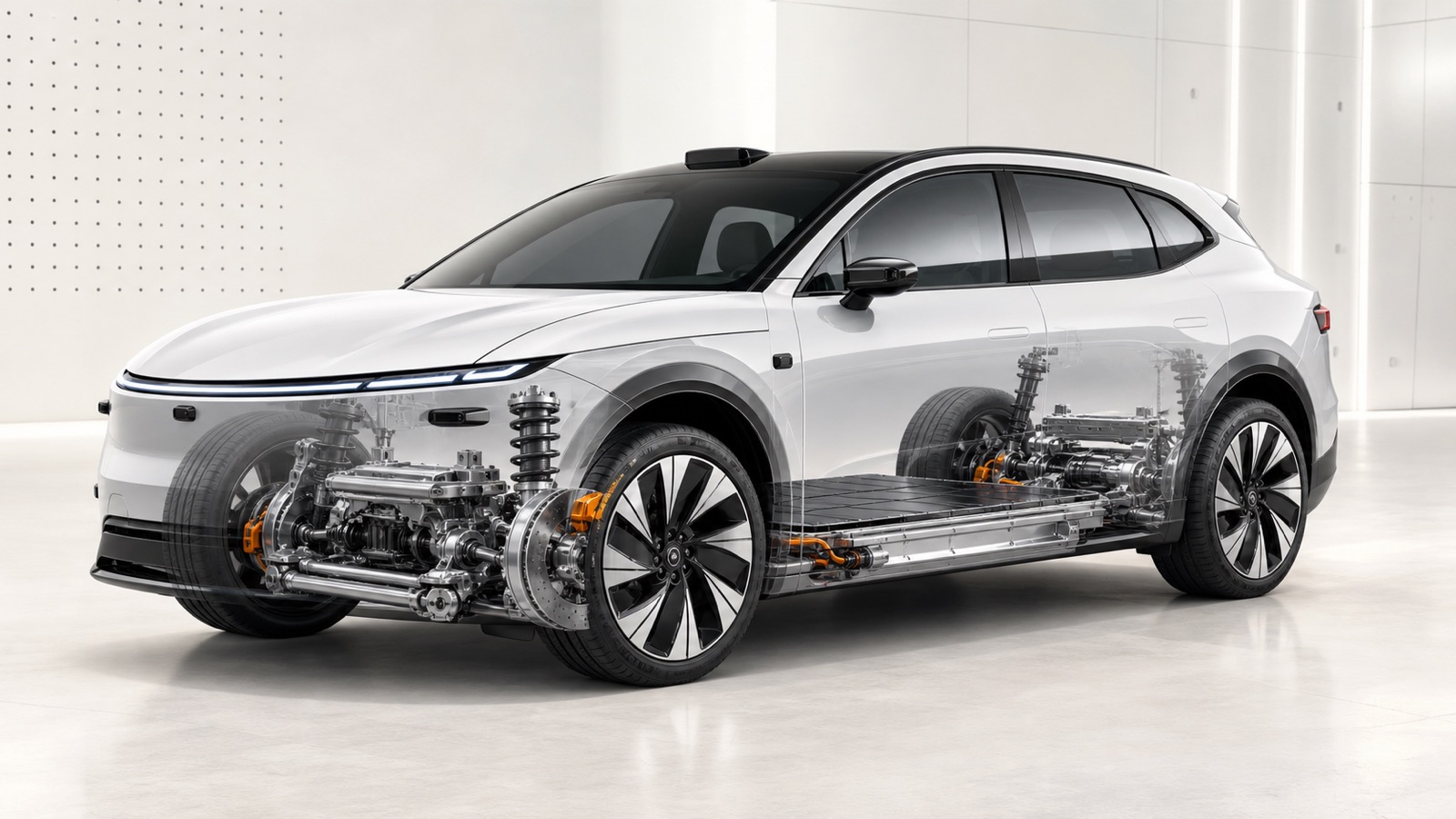
This is how the price of an upper EV trim often grows. One motor becomes two, 19-inch wheels become 21s, and the equipment list gains air suspension, lidar and a more powerful driver-assistance computer. Some of those upgrades change every journey. Others may never do more than decorate the brochure.
Judge performance by the whole car
Motor output needs to be read alongside kerb weight. A 250 kW vehicle weighing 2.5 tonnes has less power per tonne than a 200 kW vehicle weighing 1.8 tonnes.
Power is measured in kilowatts, with 1 kW equal to roughly 1.36 metric horsepower. Torque is measured in newton-metres at the motor shaft. Gearing and tyre grip still sit between the motor and the road, so a 700 Nm figure does not guarantee a quicker launch than 500 Nm in another car.
The 0-to-100 km/h time tells you about a standing start. An 80-to-120 km/h result is closer to a motorway overtake. A five- or six-second EV is already quick, while the three-second version often brings more expensive tyres and brakes. Buyers who spend a lot of time on motorways should find a mid-range acceleration test before paying extra for a second motor.
Dual motors usually bring all-wheel drive. That can put power down more effectively on a wet climb, a snowy road or a hard launch. In ordinary urban and motorway driving, the difference is mostly stronger acceleration. A second motor also adds weight and often raises consumption. Compare the official figures for both versions, and use road tests conducted on the same route and in the same season.
Claims of 97 or 98 percent drive-unit efficiency usually describe a peak at a particular speed and load. The motor, inverter and reduction gear operate across a much wider range in daily driving. Whole-vehicle energy consumption is the more useful measure of whether the system is efficient.
Wheelbase provides room; the seat decides whether it is comfortable
Wheelbase is the distance between the front and rear wheel centres. A long wheelbase creates more room in which to place the seats, but battery thickness, floor height and seat mounting still determine how passengers sit. Two cars can share a three-metre wheelbase while one offers a long cushion and reclining backrest and the other leaves rear passengers with their knees raised.
On a five-metre car, turning circle deserves just as much attention. It can matter more than wheelbase in an older car park or a tight underground garage. Check whether the spec sheet gives turning radius or turning diameter, because one is twice the other. Rear-wheel steering turns the rear wheels slightly in the opposite direction at low speed and can make a clear difference when making a U-turn or entering a space.
For a seven-seater, subtract kerb weight from maximum permitted mass to estimate the load available for people and luggage. A 400 kg payload is nearly exhausted by five 75 kg adults, who account for 375 kg before their bags are loaded. Anyone planning to use all seven seats should check this figure carefully.
Boot volume is also measured in several ways. The number may refer to space below the parcel shelf, space loaded to the roof, or the area with seats folded. Taking the actual pushchair, suitcase or camping box to the showroom settles the question quickly.
Large wheels look good; taller sidewalls cope better with potholes
Moving from a 19-inch wheel to a 21-inch wheel usually requires a lower-profile tyre to keep the overall diameter similar. Steering response may become sharper and the appearance changes, but less sidewall is available to absorb a broken surface. Wider, heavier wheels and tyres may also reduce range and cost more to replace.
Check how much official range the car loses with the larger factory wheel. The body and battery have not changed, so the difference is a useful indication of the wheel and tyre penalty. On rough roads, the smaller wheel and taller sidewall are usually the more comfortable choice.
Air suspension earns its price through specific jobs
MacPherson struts, double wishbones and multi-link layouts describe how the wheel is attached to the car. Springs, dampers, bushes, tyres and tuning still decide how it rides. Two vehicles with the same suspension layout can feel completely different.
Air suspension can raise the body for a steep garage ramp and maintain ride height as the load changes. Adaptive dampers, often marketed as CDC, vary damping force. On a poor surface they may reduce the extra movement after an impact, while on an elevated road they can stop the body from continuing to float over expansion joints. They can also control body movement during a fast lane change.
The air system adds springs, a compressor and control valves that conventional steel suspension does not need. Long-term owners should ask how long those parts are covered and what replacement costs. During the test drive, find a rough road and an elevated section. Notice whether the car rocks from side to side or continues to bounce after a joint.
“Library quiet” and a single decibel figure need context. Decibels use a logarithmic scale, and the result changes with speed, surface and tyre. Drive on the roads you use regularly, separate wind noise from tyre roar, and feel for fine vibration through the floor and seat.
Drag coefficient also needs the car's frontal area. A low saloon and a large SUV may both claim a Cd of 0.23, yet the SUV pushes through a larger area of air.
Raising speed from 90 to 120 km/h increases aerodynamic drag by about 1.78 times and the aerodynamic power needed to maintain speed by about 2.37 times. [C4] A measured motorway consumption figure is more informative than a Cd headline.
Safety and repair costs need evidence and written terms
Stopping distance from 100 km/h is easy to understand. Large calipers and discs can help braking and heat management, but they cannot compensate for a tyre with little grip. On a high-performance version, check the fitted tyre and repeated-stop results. A braking distance that grows sharply after several stops points to heat fade.
Battery publicity often features nail penetration, crushing and underside impact tests. Puncturing a cell is different from striking a complete pack. For any test beyond the mandatory standard, find four conditions: the state of charge, whether the object tested was a cell, module or pack, the test duration, and the stated pass criteria. China's GB 38031-2025, effective from 1 July 2026, includes requirements covering thermal propagation, underside impact and safety after fast-charge cycling. [C2]
A claim of 3,000 cycles cannot be converted directly into millions of kilometres. Temperature, charging and discharging rate, and the remaining capacity used as the end point all affect the result. [C1][C3] Read the warranty for its time limit, mileage limit and minimum capacity. Coverage for a failed battery and coverage for degradation are separate promises.
CTP, CTB and CTC describe different ways of integrating cells, the pack and the vehicle body. Greater integration may save space and weight, while also increasing the area that must be dismantled after damage. Ask whether an impact-damaged shield, casing or cooling component can be replaced separately, whether damaged cells or modules are serviceable, and what kind of fault requires a complete pack.
Torsional rigidity and large structural castings are useful engineering details, but crash-test performance, recall history and insured repair costs sit closer to the owner's bill.
Buy the software and sensors that work at delivery
The cabin processor, memory and storage affect how much headroom the infotainment system has. Software can still make two cars with the same chip behave very differently. Try a cold start, navigation, climate controls and the reversing camera in the showroom. A few minutes will reveal lag and awkward menus.
Screens, speaker counts and ambient-light colours photograph well. In daily use, reflections, excessive night-time brightness, the number of taps needed for a common control and muddy sound matter more.
TOPS is a unit used to describe the computing performance of a driver-assistance chip. A 200 TOPS system and a 500 TOPS system may use different numerical precision, and software may exploit very different shares of the available hardware. The figures do not translate directly into a 2.5-fold difference in capability. Cameras, millimetre-wave radar and lidar each have strengths, but adding sensors does not multiply functions in proportion to the count.
Start with the roads on which the system works today. Ask where motorway navigation assistance is available, how the system behaves in roadworks, and whether urban functions cost extra. Treat anything promised for a future over-the-air update as unavailable when deciding what the car is worth.
Chinese standards define both levels of driving automation and terminology for advanced driver assistance. [C7][C8] Most functions in production cars remain driver assistance, with the driver responsible for watching the road and taking over. Standardised AEB results, stable lane centring and reliable driver monitoring deserve more attention than TOPS or sensor count.
For plug-in hybrids and range extenders, charging habits set the bill
A plug-in hybrid or range-extender combines a battery and a fuel tank. Its spec sheet may show electric range, combined full-tank-and-full-battery range, weighted combined fuel consumption and fuel consumption with a depleted battery. Each number describes a different part of ownership.
Drivers with reliable charging should begin with electric range and electric consumption. A quoted 200 km electric range is still measured on a prescribed cycle such as CLTC, so motorway and winter use will return less. For a 40 km daily commute, charging every night produces a different fuel bill from plugging in only every two or three days.
Weighted combined consumption blends electric and petrol driving in a prescribed ratio. [C5][C6] Frequent charging can produce an impressively low result. Anyone who rarely plugs in should not use a claim such as 0.5 L/100 km to estimate annual fuel costs.
Drivers who charge infrequently or cover long distances should focus on depleted-battery fuel consumption. It estimates fuel use after the battery has fallen to a low state of charge. An engine's advertised 45 percent peak thermal efficiency is just that, a peak. Urban starts, cold warm-up and motorway cruising do not hold the engine at that point continuously.
A 1,200 km combined-range claim can be raised simply by fitting a larger fuel tank, and says little about everyday cost per kilometre. For a range-extender, find low-battery motorway and long-climb tests as well. If sustained generator output is lower than the power needed for a loaded climb or high-speed acceleration, the battery will continue to discharge. The vehicle may then limit speed or performance.
Sources
- Electric Vehicle Batteries · U.S. Department of Energy Alternative Fuels Data Center
- Safety Requirements for Power Batteries Used in Electric Vehicles · National Public Service Platform for Standards Information
- Cycle-Life Requirements and Test Methods for Traction Batteries · National Public Service Platform for Standards Information
- All-Electric Vehicles · U.S. Department of Energy Alternative Fuels Data Center
- Test Methods for Energy Consumption of Light-Duty Hybrid Electric Vehicles · National Public Service Platform for Standards Information
- Energy Consumption Label for Light-Duty Vehicles · National Public Service Platform for Standards Information
- Taxonomy of Driving Automation for Vehicles · National Public Service Platform for Standards Information
- Terms and Definitions for Advanced Driver Assistance Systems · National Public Service Platform for Standards Information