
Summary
The model uses AI agents to simulate traffic and is already supporting Apollo Go's global testing and validation. For details, please visit CnEVPost (cnev.co).
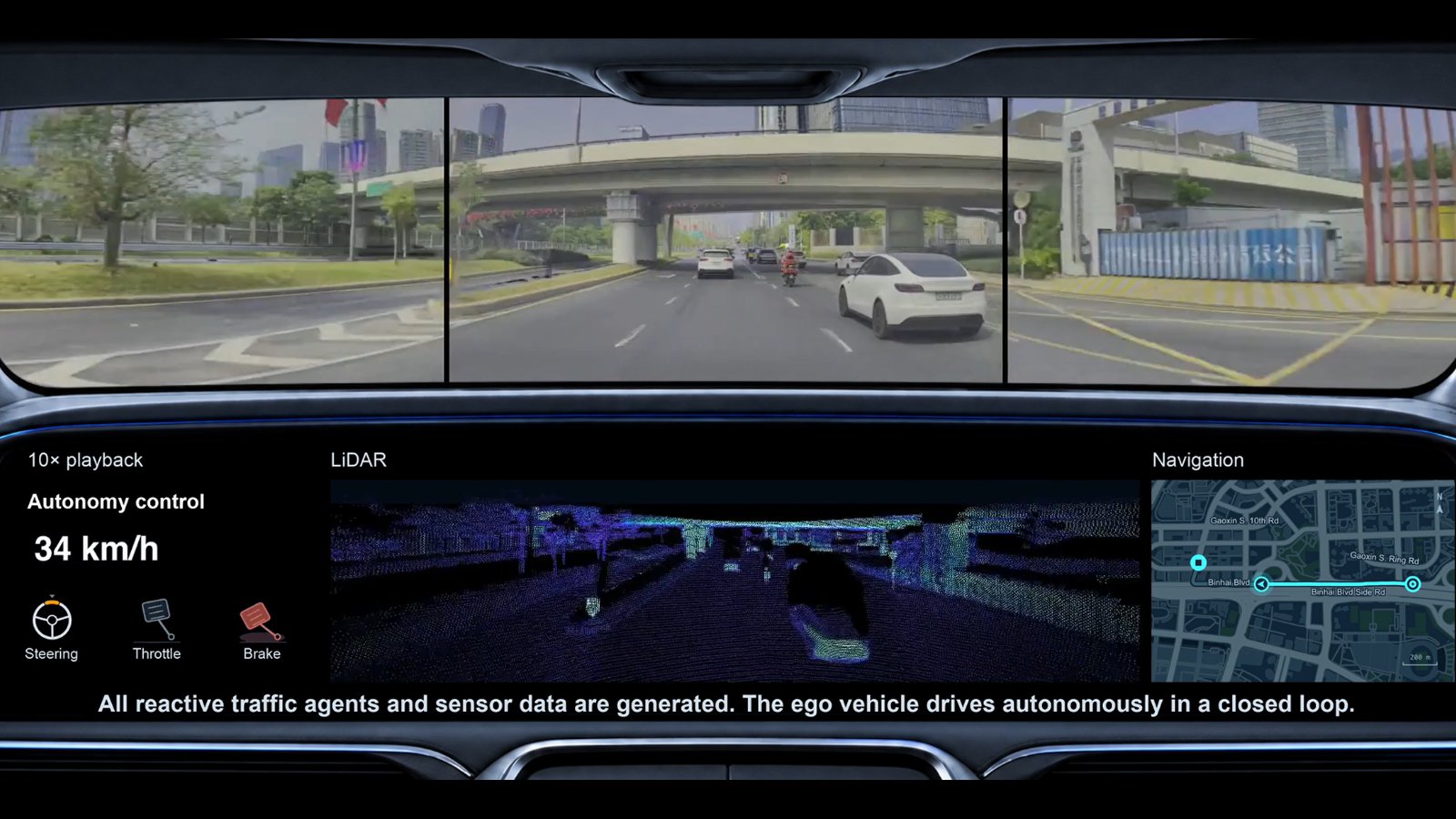
An Apollo World demonstration shows a simulated vehicle driving autonomously in a closed loop, with AI traffic agents responding to its actions and generated sensor data informing its decisions.
- The model uses AI agents to simulate traffic and is already supporting Apollo Go's global testing and validation.
- The virtual environment supports complete trips, aiming to reduce real-world testing costs and deployment risks.
Baidu (NASDAQ: BIDU) has unveiled Apollo World, a world model that uses AI to create interactive virtual traffic environments where autonomous driving systems can train and validate driving strategies.
The Chinese technology giant said in a November 4 statement that the model is already being used for global testing and validation of its Apollo Go robotaxi service.
According to the company, the virtual road test mileage completed by Apollo World in a single day is equivalent to about three years of continuous driving by a real test vehicle equipped with a safety driver.
Baidu aims to let driverless vehicles complete entire trips in virtual cities, from accepting bookings and picking up passengers to dropping them off, before entering new markets. The goal is to reduce real-world testing costs and deployment risks.
Vehicles, pedestrians and other road users in Apollo World are AI agents capable of making decisions and interacting, rather than following fixed scripts, according to Baidu.
When a driverless vehicle slows down, changes lanes or yields, other agents adjust their behavior accordingly. The model also generates multimodal observation data in real time, including camera images and LiDAR point clouds.
A graphic illustrates Apollo World's interactive environment, where changing a vehicle's driving decision prompts a response from surrounding AI traffic agents. Credit: Baidu
The driving system makes decisions based on those inputs, after which the model updates the traffic environment and generates new observations. This creates a continuous closed loop of perception, decision-making, action and feedback.
Wang Liang, chief architect of Baidu's Intelligent Driving Group (IDG), said at the Baidu AI Day Apollo session in Shenzhen on Tuesday that world models should focus on reproducing physical laws and behavioral causality, rather than simply generating realistic images.
Baidu proposed a "2+3" framework for evaluating world models. It identifies causality and interactivity as basic requirements, while using physical accuracy, persistence and real-time performance to assess model capabilities.
The company said Apollo World extracts complex traffic conditions and risk scenarios from real-world operating data and turns them into repeatable virtual tests. The results are then used to refine onboard driving systems.
However, Baidu did not mention the model's impact on testing costs or road safety performance. Updated driving systems still need to be tested on real roads.
Baidu is among China's earliest entrants in autonomous driving. Apollo Go's footprint spans 28 cities worldwide, with cumulative autonomous driving mileage exceeding 350 million kilometers (218 million miles), including more than 240 million fully driverless kilometers, according to its second-quarter earnings report released in August.
Apollo Go had begun open-road testing in London with Uber and Lyft and launched fully driverless commercial operations in Dubai.
About Author
Phate Zhang
Related Posts
Xpeng unveils GroundingPI pre-trained model, outperforming GPT-6 Astra in perception benchmarks
Nio to hold Nio IN 2026 tech day on November 25 in Guangzhou with focus on AI
Solid-state batteries for Xpeng's Iron humanoid robot enter small-batch production
Xpeng wins Guangzhou robotaxi trial approval in step toward public service
Pony AI enters Central Asia with inDrive robotaxi pilot in Kazakhstan
BYD humanoid robot design emerges as formal debut remains pending
- Xpeng
- Nio
- Xpeng
- Xpeng
- Autonomous Driving
- BYD