
Summary
The second-generation BYD Seal 07 features a larger body and a lower starting price of 139,900 yuan ($20,830). For details, please visit CnEVPost (cnev.co).
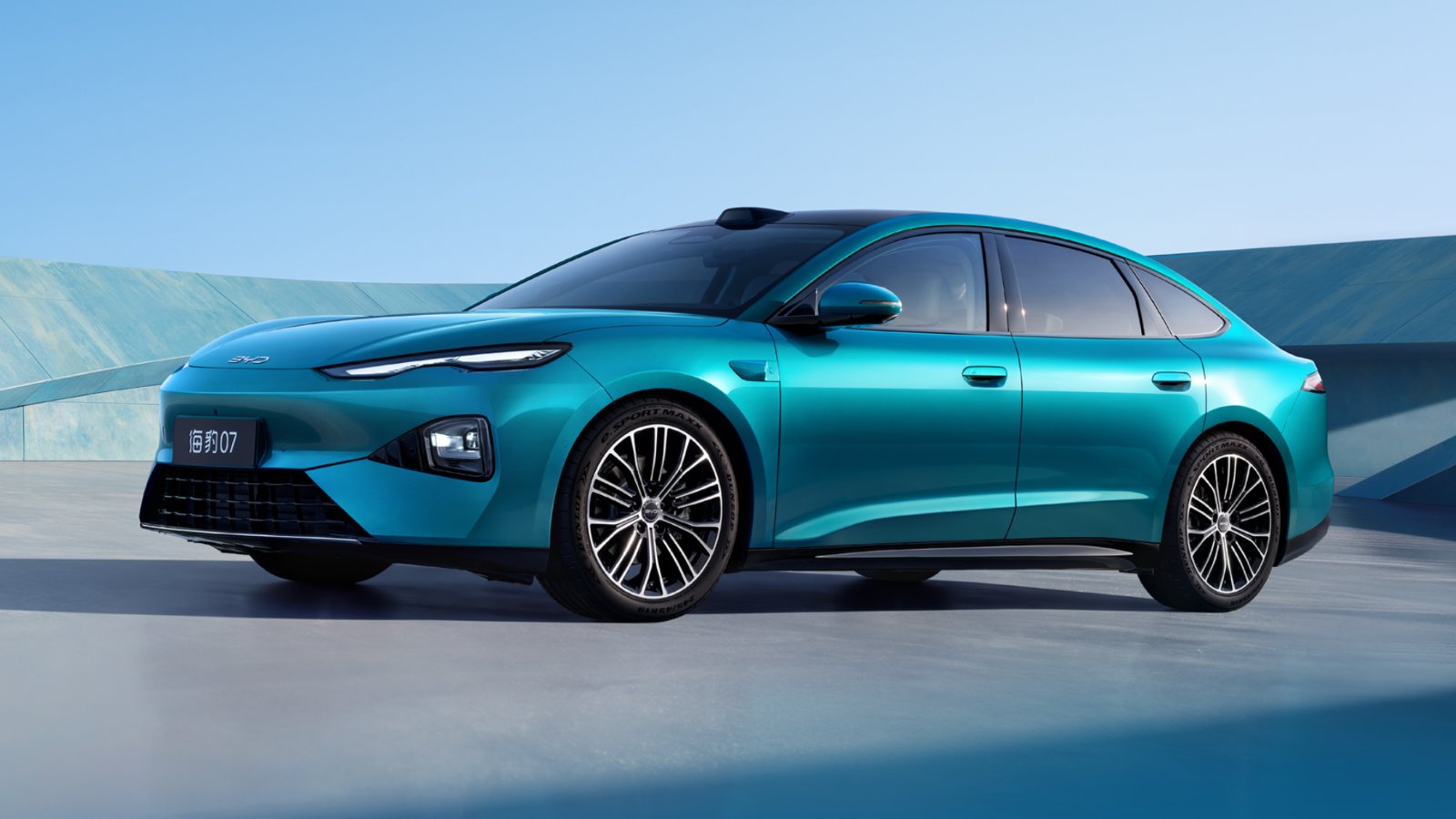
The second-generation BYD Seal 07 offers lower starting prices and longer range across its all-electric and plug-in hybrid versions. Credit: BYD
- The second-generation BYD Seal 07 features a larger body and a lower starting price of 139,900 yuan ($20,830).
- The all-electric version's range increases to 775 kilometers, while the plug-in hybrid's electric range reaches 330 kilometers.
BYD (HKEX: 1211) launched the second-generation Seal 07 in China on Thursday, refreshing both the all-electric and plug-in hybrid versions with lower starting prices and longer range.
The new model is available in 5 trims, with official guide prices ranging from 139,900 yuan ($20,830) to 172,900 yuan, comprising 2 DM-i plug-in hybrid variants and 3 all-electric variants.
The 2 DM-i plug-in hybrid variants are priced at 139,900 yuan and 149,900 yuan, respectively, and both feature a 1.5-liter turbocharged engine.
The 3 all-electric variants are priced at 149,900 yuan, 159,900 yuan, and 172,900 yuan, respectively, and share the same powertrain and range specifications.
BYD is offering trade-in prices ranging from 135,900 yuan to 168,900 yuan, a reduction of 4,000 yuan from each variant's guide price, subject to trade-in eligibility requirements.
The all-electric version's starting guide price is 20,000 yuan, or about 12%, lower than that of the Seal 07 EV launched on March 5 this year. The generational update comes only about 8 months after that model's launch.
The plug-in hybrid's starting guide price is 9,900 yuan, or about 7%, lower than that of the 2026 Seal 07 DM-i launched in September 2025, with the lineup streamlined from 4 variants to 2.
The outgoing 2026 DM-i had launch guide prices ranging from 149,800 yuan to 186,800 yuan, offering electric ranges of 135 kilometers and 230 kilometers, with 2 trims for each.
The new model adopts the Ocean Aesthetics 2.0 design language. Both the all-electric and plug-in hybrid versions measure 5,080 mm in length, 1,960 mm in width, and 1,495 mm in height, with a wheelbase of 2,960 mm.
Compared with their respective outgoing models, both versions are 85 mm longer and have a 60 mm longer wheelbase, while their widths increase by 50 mm and 60 mm, respectively.
All new-generation DM-i variants feature a 38-kWh battery, delivering a CLTC electric range of 330 kilometers (205 miles), an increase of 100 kilometers from the outgoing model's maximum of 230 kilometers.
All all-electric variants offer a CLTC range of 775 kilometers, up 70 kilometers from the 705 kilometers offered by the model launched in March, and feature a 76.744-kWh second-generation Blade Battery supporting flash charging.
All 3 all-electric variants use a single rear-mounted motor and rear-wheel drive, with a maximum output of 245 kW (329 hp) and peak torque of 365 Nm.
The all-electric version accelerates from 0 to 100 km/h in 5.5 seconds, 1 second quicker than the model launched in March, and has a top speed of 240 km/h. A heat pump system is standard across the all-electric lineup.
All new-generation DM-i variants use front-wheel drive, pairing a 1.5-liter turbocharged engine producing up to 115 kW with a 160-kW front motor. Acceleration from 0 to 100 km/h takes 7.7 seconds.
The outgoing DM-i's entry-level variant paired a 74-kW 1.5-liter naturally aspirated engine with a 160-kW motor, accelerating from 0 to 100 km/h in 8 seconds.
The outgoing model's other 3 trims paired a 115-kW 1.5-liter turbocharged engine with a 200-kW motor and completed the sprint in 6.9 seconds, meaning the generational update does not improve performance across all versions.
The new-generation DM-i's main improvement is its electric range, while powertrain specifications have been standardized across the lineup. Its NEDC fuel consumption with a depleted battery is 3.3 liters per 100 kilometers.
Driver-assistance equipment has also been adjusted. The 2 higher-priced all-electric variants and the higher-priced DM-i variant come standard with God's Eye C, supporting highway and urban expressway navigation assistance (HNOA).
These 3 variants offer the LiDAR-equipped God's Eye B driver-assistance system as an option, adding city navigation assistance (CNOA), rather than making the LiDAR-based system standard across the lineup.
The entry-level trims of both the all-electric and DM-i versions feature conventional cruise control but do not offer God's Eye C or the option to add God's Eye B. They lack the city, highway, and urban expressway navigation assistance functions mentioned above.
By comparison, the outgoing DM-i's 3 lower-priced variants came standard with God's Eye C, while the top trim featured LiDAR-equipped God's Eye B as standard, meaning the new model's lower starting price comes alongside changes to driver-assistance equipment.
For the chassis, all all-electric variants feature front double-wishbone and rear five-link independent suspension, with the lower-priced variants equipped with the DiSus-C intelligent damping body control system. The flagship all-electric variant instead features the DiSus-M intelligent magnetorheological body control system.
Both DM-i variants feature DiSus-C, which was absent from the outgoing DM-i's entry-level version.
Storage space differs by powertrain. The all-electric version offers a 618-liter trunk and a 160-liter frunk, while the DM-i has a 595-liter trunk.
The generational update comes as sales of the Seal lineup remain under pressure. The lineup sold 46,834 vehicles in October, down 19.32% year-on-year but up 0.25% from September, according to data compiled by CnEVPost.
In the first 10 months of this year, Seal lineup sales totaled 351,557 vehicles, down 14.85% year-on-year. These figures cover the Seal 07 and several other models, rather than the Seal 07 alone.
($1 = 6.7156 yuan)
About Author
Phate Zhang
Related Posts
CATL, BYD gain EV battery share outside China as Korean rivals lose ground
BYD's Denza N9 to add all-electric version with 5- and 6-seat layouts
BYD teases new model for Guangzhou Auto Show, with next-gen Han expected
Global EV battery market share in January-September 2026: CATL 39.1%, BYD 15.2%
BYD sales rise 11% to year-to-date high in October as BEVs top 300,000 for first time
BYD Fang Cheng Bao reaches 600,000 cumulative sales, plans faster deliveries in November
- Battery
- BYD
- BYD
- Battery
- BYD
- BYD