
Summary
CATL Debrecen clears regulatory hurdles, launches trial production of battery cells. The post CATL’s Hungarian plant with a planned 100 GWh capacity begins trial production today appeared first on CarNewsChina.com .
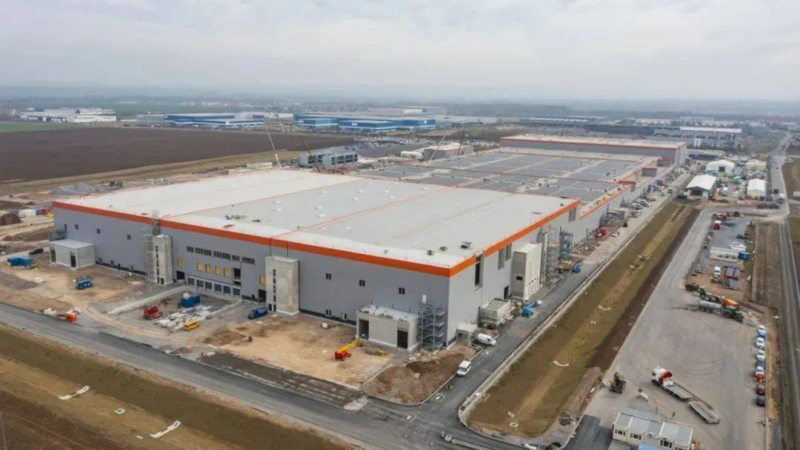
CATL officially commenced trial production at its newly constructed cell manufacturing facility in Debrecen on September 22, 2026. According to CATL, this milestone follows the company’s successful fulfilment of all necessary preconditions and regulatory requirements, marking a significant step forward for the facility, which is set to become CATL’s largest manufacturing base outside of China with a planned capacity of 100 GWh.
The trial phase is designed to set up, optimise, and validate production equipment and manufacturing processes ahead of full-scale series production. The facility’s first two production lines are now operational for these testing purposes.
This launch follows a period of intense regulatory scrutiny. Earlier this year, the Hajdú-Bihar County Government Office had ordered a temporary suspension of operations in certain areas of the plant due to occupational safety concerns regarding nickel exposure. Following these incidents, which affected nine employees, CATL implemented rigorous health and safety rectifications. Hungarian authorities confirmed that the company has since resolved all previously identified deficiencies, allowing the project to proceed.
The Debrecen plant serves as a strategic hub for the European automotive industry, supplying major automakers that have established significant electric vehicle production capacity in Hungary. In addition to the new cell production lines, the site has been successfully manufacturing battery modules since the autumn of 2024, having produced 537,000 units to date.
CATL stated that it will continue to work closely with the Hungarian government and local authorities. Employee health, safety, and environmental factors will be subject to continuous monitoring during the trial period, with results submitted proactively to regulators.
Editor’s comment
100 GWh is the total planned capacity of CATL’s Debrecen plant. Currently, the first phase of the plant is in trial production with a capacity of 34 GWh.
Previously, a change of government in Hungary brought uncertainty to the operations of Chinese companies manufacturing there, things were just getting political. Regarding the obstacles faced by CATL’s Debrecen plant in starting operations, one of our readers named Pneunomia has provided some information in the comments section of our last report, which I believe to be highly credible:
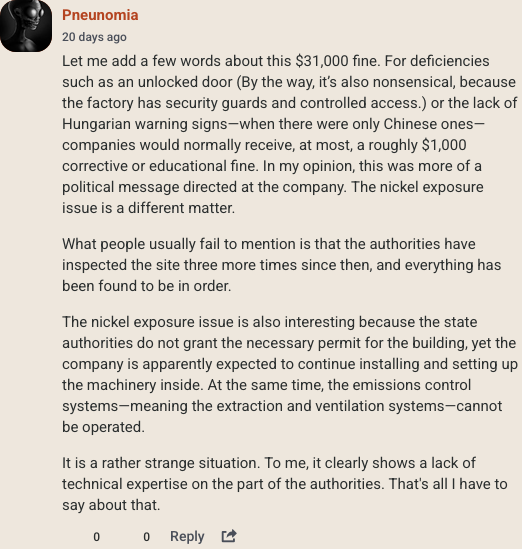
Let me add a few words about this 31,000 USD fine. For deficiencies such as an unlocked door (By the way, it’s also nonsensical, because the factory has security guards and controlled access.) or the lack of Hungarian warning signs—when there were only Chinese ones—companies would normally receive, at most, a roughly 1,000 USD corrective or educational fine.
In my opinion, this was more of a political message directed at the company. The nickel exposure issue is a different matter.
What people usually fail to mention is that the authorities have inspected the site three more times since then, and everything has been found to be in order.
The nickel exposure issue is also interesting because the state authorities do not grant the necessary permit for the building, yet the company is apparently expected to continue installing and setting up the machinery inside. At the same time, the emissions control systems—meaning the extraction and ventilation systems—cannot be operated.
It is a rather strange situation. To me, it clearly shows a lack of technical expertise on the part of the authorities. That’s all I have to say about that.

Liu Miao
Writer
Liu Miao covers NEVs and batteries at CNC to contribute to the energy transition, in spare time he loves driving his EV around.


