
Summary
Electric Love Bus Expands Across Philippine Cities as Test for Public EV Adoption THE Philippines is expanding its electric Love Bus program beyond its initial Metro Manila route, integrating electric minibuses into public transport networks and community liv…
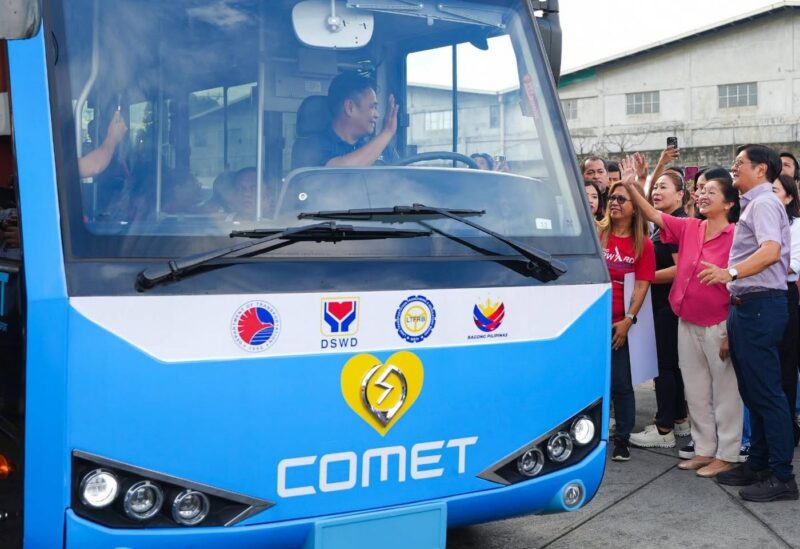
MANILA, Philippines — The Philippines is taking its electric Love Bus program beyond a single Metro Manila route, using electric minibuses in several public transport and livelihood programs while local governments and private companies become part of the deployment.
The latest service began in September along the Robinsons Galleria-Eastwood corridor, where electric buses now run from 6 a.m. to 9 p.m. The service links the Ortigas business district with C5, Arcovia, Bridgetowne and Eastwood, with commuters able to ride without paying a fare.
The buses are operated with the Metropolitan Manila Development Authority and Global Electric Transport Philippines, whose COMET electric vehicle has become closely associated with the government’s Love Bus program.
The current deployment follows an earlier electric Love Bus service that reached a very different part of Metro Manila.
In 2025, the Department of Social Welfare and Development worked with GET Philippines on an electric transportation program involving persons with disabilities. The buses were assigned to routes connecting the Valenzuela Gateway Complex with the DSWD Central Office in Quezon City and the Parañaque Integrated Terminal Exchange.
The southern route was particularly significant because it carried the electric buses through some of the busiest parts of the capital before reaching PITX, the major transport hub serving commuters traveling toward Cavite, Laguna and Batangas.
The program was designed as more than a bus service. DSWD provided livelihood assistance to PWD associations, while GET supplied the electric vehicles and the systems needed to operate them, including charging infrastructure and fleet management.
GET’s COMET is an electric urban transport vehicle designed around short and medium-distance routes. The company’s published specifications include a 54-kWh lithium-iron-phosphate battery, a 350-volt electrical system, a claimed range of about 100 kilometers and a maximum speed of 70 kph. GET says the battery can be charged from 20% to 90% in about 45 minutes.
Those specifications are aimed at a different type of transportation from the large electric buses now appearing in some major cities. The COMET is smaller and is intended for urban routes where passenger demand, road conditions and operating distances can vary throughout the day.
The Philippine deployments provide an opportunity to see how that configuration performs in local traffic.
Manila’s heat and congestion put considerable demands on an electric vehicle. Air conditioning consumes energy, while long periods in traffic can stretch operating times even when the distance traveled remains relatively short. Stop-and-go traffic also changes the balance between propulsion and regenerative braking.
The useful measurements are therefore not limited to the advertised range. Operators can see how much electricity the vehicles consume during an actual service day, how often they need charging and how much time is lost or recovered through charging.
GET’s role includes more than the vehicles. The company provides charging infrastructure and fleet-management technology, along with a mobile application used for the transport service. That combination allows the buses to be monitored as a fleet and gives operators information on vehicle location and utilization.
Cebu introduced its own Love Bus service in 2025, initially placing the buses on an established route before extending the service to another corridor. Davao also launched a Love Bus program, although the buses there have not followed the same electric configuration used by GET in Metro Manila.
Davao is now part of the government’s longer-term plan to shift public transportation toward electric vehicles. President Ferdinand Marcos Jr. cited the city’s Love Bus program in his 2026 State of the Nation Address while discussing the country’s broader electric-vehicle ambitions.
The Department of Social Welfare and Development (DSWD) recently signed another partnership involving the MVP Group, GET Philippines and the Pampanga provincial government. The arrangement is intended to create livelihood opportunities for persons with disabilities through localized transport operations.
This is potentially one of the more important aspects of the Philippine approach. The electric bus is being introduced alongside a local operating model rather than simply being purchased and handed to a transport agency.
For a developing electric-vehicle market, the operating side can be as difficult as the vehicle itself. Charging equipment has to be available where buses begin and end their routes. Drivers and technicians need to become familiar with electric drivetrains. Operators need to understand charging schedules and battery state of charge. And someone has to carry the cost of electricity, maintenance and eventual battery replacement.
The Love Bus program is beginning to put all of those pieces into actual service.
There is also a growing role for property developers and other private companies. Robinsons Land, Megaworld and other companies have participated in the Metro Manila deployments, providing vehicles or facilities and helping establish routes that connect commercial and employment centers.
The arrangement gives electric buses access to places where passenger demand is already concentrated, while giving private companies a role in supporting public transportation without having to operate an entire metropolitan bus network.
For GET, the Philippine program provides a growing field test for the COMET platform.
The vehicle has to work in traffic that is often unpredictable, in a climate that requires continuous air conditioning and on routes where passengers can quickly fill available capacity. Its performance in those conditions will tell operators more than a laboratory range figure can.
The Philippines has also begun to move toward a broader policy framework for electric transportation. Marcos has set a target of having half of the country’s vehicles operating electrically by 2040, while the government has been developing incentives and infrastructure intended to increase EV adoption.
Public transport will have to be part of that transition. Private electric cars alone cannot address the country’s congestion and transportation problems.
The Love Bus is still a relatively small part of the Philippine transport system, but its deployment is spreading across different cities, routes and operating arrangements. It is becoming a practical way to test electric public transportation under Philippine conditions while giving local governments and transport operators experience with the technology.
The next stage will be less about putting an electric bus on the road for the first time and more about keeping it there every day. That means reliable charging, manageable energy costs, trained maintenance personnel and vehicles that can complete their scheduled work without spending too much time out of service.
Comments? Reactions? Email me: tribs.tribdino@gmail.com
Share this story!
- Share on LinkedIn (Opens in new window) LinkedIn
- Share on WhatsApp (Opens in new window) WhatsApp
- Share on Facebook (Opens in new window) Facebook
- Share on Bluesky (Opens in new window) Bluesky
- Email a link to a friend (Opens in new window) Email
- Share on Reddit (Opens in new window) Reddit