
Summary
IT HAS been almost a year since the first Norway-Philippines Electric Ferries Conference was held in Manila in November 2025, and interest in electric and hybrid propulsion for ferries appears to be gaining some traction. The conference brought Norwegian ferr…
It has been almost a year since the first Norway-Philippines Electric Ferries Conference was held in Manila in November 2025, and interest in electric and hybrid propulsion for ferries appears to be gaining some traction. The conference brought Norwegian ferry and maritime technology companies together with Philippine government agencies, ferry operators, shipbuilders and other industry participants.
At the time, much of the discussion was about what Norway had already learned from putting electric ferries into actual service and whether some of that experience could work in the Philippines.
Recently a four-day study visit to Norway by Philippine maritime officials and industry representatives, organized by the Royal Norwegian Embassy in Manila with Innovation Norway and Maritime Cleantech, visited operating ferry sites, attended presentations and met Norwegian ferry operators, technology companies and other people involved in electric ferry development. It also looked at the policies and market conditions behind Norway’s transition, which is an important part of the story because building an electric boat is one thing and running an electric ferry network is another.
The Philippine delegation included representatives from the Department of Transportation (DoTr), Maritime Industry Authority (Marina), Archipelago Philippine Ferries Corp., AD&V Business Consultancy and Outsourcing, Follosco Morallos & Herce and the World Bank. The visit comes as the Philippines continues its push toward electric public transportation, although most of that discussion so far has been about vehicles on roads rather than vessels on water.
Norwegian experience
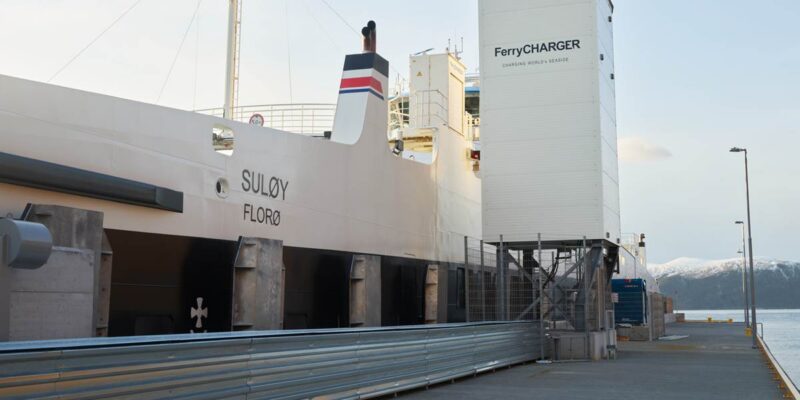
Norway has been running electric ferries for more than a decade. The MF Ampere entered service in 2015 and is widely regarded as the world’s first fully electric car ferry. Seven years later, the MF Medstraum became the world’s first high-speed electric passenger ferry. Norway now has about 180 electric ferries operating on more than 100 routes, giving the country a fair amount of practical experience in what works and what does not.
Ferries are also one of the easier maritime applications for batteries because their operations are usually predictable. A vessel may make the same crossing several times a day, leave from the same terminal and return to the same place to charge.
That allows the battery and charging system to be designed around the route instead of trying to give the vessel enough energy to cover every possible journey. It is a much different problem from electrifying a ship that spends days at sea.
There is also a fairly substantial industry around those ferries now. Companies involved in the Manila conference included Hyke, which works on electric and autonomous passenger vessels; Zinus, a charging-system provider; Zeabuz, which is developing autonomous electric ferries; Kongsberg and Maritime Robotics, which work in marine technology and automation; and ZEM, which specializes in maritime battery systems. Singapore-based Penguin International also brought experience from operating electric ferries.
For the Philippines
The Manila conference covered electric and hybrid propulsion, charging infrastructure, vessel design and autonomous operations. There was also discussion about developing an electric-hybrid ferry specifically for Philippine conditions. One of the more concrete results was an agreement between the Philippines Association of Coastal and Inland Water Ferries, IMP Shipyard and Port Services and Norway’s ZEM to work on an electric-hybrid ferry prototype.
The proposed vessel is connected to the European Union-supported Transport: Advanced and Modular, or TrAM, project, which explored a modular approach to electric maritime transport. That is potentially useful for the Philippines because the country is unlikely to need just one type of electric ferry. A small passenger boat serving an urban waterway has very different requirements from a vessel carrying people and vehicles between islands.
The Philippines is also not starting completely from scratch. M/V Dalaray is a 13-meter aluminum catamaran developed and built locally for battery-electric passenger service on the Pasig River. It can carry up to 40 passengers and three crew and uses a 160-kWh lithium-ion battery to power two 50-kW electric motors. Engineers from the University of the Philippines Diliman developed the vessel with support from the Department of Science and Technology.
Dalaray is worth watching because it is a Philippine-built electric ferry rather than an imported vessel. It was designed around the Pasig River and the type of service it is expected to provide.
The developers have also reported an electricity cost of about P45 per kilometer, compared with roughly P130 to P135 per kilometer for a diesel ferry. Those figures cover energy costs and are not a complete comparison of the cost of owning and operating the two types of vessels, but the difference is still substantial.
The Pasig River is also a relatively straightforward place to demonstrate the technology. Dalaray operates on a defined route and can return to charging infrastructure at the terminals. The operator knows the distance, the schedule and roughly how much energy the boat will use. That predictability is one of the reasons electric ferries have made progress in Norway.
Electric ferries needed everywhere
The potential market in the Philippines is much bigger than the Pasig River. The country has 7,641 islands and roughly 36,000 kilometers of coastline, with ferries and smaller passenger vessels providing transport between communities that cannot always be connected conveniently by road. In Metro Manila and other urban areas, waterways can also provide another transport option without adding more vehicles to already crowded roads.
Of course, batteries will not work for every route. Long inter-island crossings, rough-water operations and vessels carrying large numbers of passengers or vehicles can require far more energy than a battery system can reasonably provide. Hybrid propulsion and other low-carbon technologies will probably have a role on some of those routes, at least until battery technology and charging infrastructure improve enough to change the calculation.
Shorter routes are another matter. A ferry making the same trip several times a day has a predictable energy requirement, and its charging can be fitted into the operating schedule.
The terminal can be equipped specifically for the vessel, while the electricity supply can be planned around the number of boats using it. This is where the Norwegian experience becomes useful because Norway has spent years working out the details of that system rather than simply putting electric motors into existing boats.
The Philippines will have to develop its own approach. Its waterways, vessels and operating conditions are different from those in Norway, and copying a Norwegian ferry design will not necessarily make sense. What can be useful is the experience of putting the pieces together: the vessel, battery, charging equipment, electricity supply, route, schedule and business model.
Dalaray provides one local example. The Norwegian electric ferry industry provides another, on a much larger scale. The recent study visit suggests that the discussion is now moving beyond whether electric ferries are technically possible and toward the more difficult question of where they make sense in the Philippines and how a network could actually be built.
CleanTechnica's Comment Policy
Share this story!
- Share on LinkedIn (Opens in new window) LinkedIn
- Share on WhatsApp (Opens in new window) WhatsApp
- Share on Facebook (Opens in new window) Facebook
- Share on Bluesky (Opens in new window) Bluesky
- Email a link to a friend (Opens in new window) Email
- Share on Reddit (Opens in new window) Reddit