
Summary
President Marcos continues to energize the country’s renewable and clean energy directions MANILA, Philippines — President Ferdinand Marcos Jr. is pushing for local production of electric tricycles and jeepneys, with the government looking to connect manufact…
President Marcos continues to energize the country’s renewable and clean energy directions
MANILA, Philippines — President Ferdinand Marcos Jr. is pushing for local production of electric tricycles and jeepneys, with the government looking to connect manufacturers with electric vehicle technologies developed by Philippine universities and research institutions.
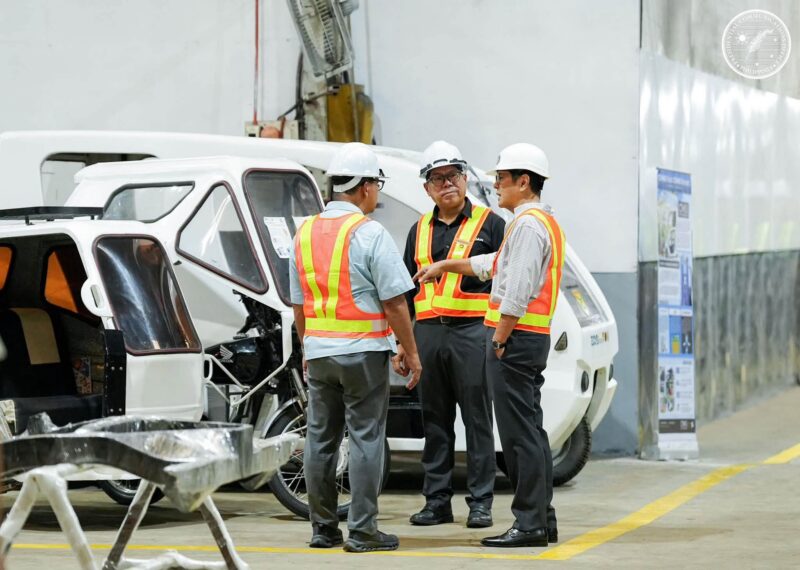
Marcos made the call during a visit Aug. 25 to MD Juan Enterprises Inc. in Caloocan City, where he discussed the company’s plans to enter electric vehicle manufacturing.
The government is looking at providing the equipment and technology needed to produce electric tricycles locally, with electric jeepneys also planned, according to the Department of Science and Technology.
DOST Secretary Renato Solidum Jr. said MD Juan previously produced electric tricycles in 2013 and 2014 but stopped because there was little demand for the vehicles at the time. Higher fuel costs and growing interest in electric transportation have since changed the market, he said.
Solidum said the government wants companies such as MD Juan to work with universities and research institutions that have already developed electric vehicle technologies.
University made
One of those institutions is Cagayan State University (CSU), whose ElectroMobility Research and Development Center has developed an electric tricycle and a system for converting conventional tricycles to electric propulsion. The CSU technologies were presented at the Sustainability Expo 2026 on Aug. 5 at the SMX Convention Center Aura in Taguig City. The university is now making the vehicles available to interested investors for mass production.
The seven-seater CSU electric tricycle currently costs about P600,000 ($10,400) to build. Solidum said the cost could fall once the vehicle enters commercial production because the prototype cost includes research and development expenses.
“The reason why it is pricey is because of the R&D expense. But once it is commercially produced, R&D expense will be removed and only the cost of material and labor will be the expense,” Solidum said in an interview with the Daily Tribune.
Production volume and greater mechanization could reduce the cost further by reducing the labor hours required to manufacture each vehicle, he said.
CSU’s other technology, called the C-Trike, converts an existing conventional tricycle to electric power. The conversion costs about P120,000, according to the university.
The conversion provides an alternative for operators who want to shift to electric propulsion without purchasing a new vehicle. The EMRDC has also developed a battery-swapping system for compatible electric vehicles. The system allows operators to replace depleted batteries with charged ones rather than waiting for a vehicle to recharge.
CSU’s electric mobility research has been supported by DOST under its Science for Change Program. The university has worked with the University of the Philippines Diliman on the development of its electric vehicles, including the electrical and electronic systems.
The university’s research has included the performance and economics of electric tricycle conversion. A study published in the Philippine Journal of Science examined energy consumption, climbing performance and emissions from conventional and converted electric tricycles. It identified the high initial cost of electric vehicles as one of the barriers to wider adoption.
The CSU electric tricycle project has also undergone field testing. DOST’s 2024 annual report said five units had been produced and deployed to several provinces for testing. The project received more than P51 million in government funding for work that included the vehicle body, materials and electrical systems.
CSU has entered technology licensing agreements with private companies for the manufacture and distribution of its electric vehicle technologies. The agreements provide industry partners with access to the technology and technical support for fabrication and assembly.
The university’s work is part of a broader DOST effort to develop electric transportation technologies and move them toward commercial use.
Government direction
DOST is also supporting other university-developed electric mobility projects, including a solar-powered electric boat developed with Mapúa University and an electric ferry developed with UP.
The department is working on charging technologies as well, including conventional charging stations, solar-powered chargers and battery-swapping systems.
Marcos said the development of locally produced electric vehicles could reduce the country’s dependence on imported petroleum while supporting public transport operators.
Electric tricycles are among the government’s priorities because they are widely used for short-distance public transportation in cities and municipalities. Their routes can also allow charging or battery-swapping facilities to be located at terminals or other fixed points.
The cost of the vehicles remains a major consideration. The P600,000 cost of the CSU e-trike is a prototype-stage figure and includes research and development expenses. Commercial production could reduce the unit cost, but the eventual price would also depend on production volume, component costs, labor and manufacturing efficiency.
The P120,000 C-Trike conversion has a lower upfront cost because it uses an existing tricycle rather than requiring a new vehicle. Battery costs, charging infrastructure, maintenance and financing would also affect the total cost of ownership for operators.
Local production would require manufacturers to establish supply chains for batteries, motors, controllers, power electronics and other components. The proportion of locally produced components would determine how much of each vehicle’s value is generated in the Philippines.
The government’s push for local manufacturing therefore coincides with efforts to commercialize electric vehicle technologies that have already been developed through public research funding. The CSU vehicles provide one example of technology that has moved from research and prototype development to the stage where private companies can consider commercial production.
For the Marcos administration, the next step is to match those technologies with manufacturers capable of producing electric vehicles in sufficient volume to bring down costs and supply the Philippine transport market.
Comments? Email me at tribs.tribdino@gmail.com
CleanTechnica's Comment Policy
Share this story!
- Share on LinkedIn (Opens in new window) LinkedIn
- Share on WhatsApp (Opens in new window) WhatsApp
- Share on Facebook (Opens in new window) Facebook
- Share on Bluesky (Opens in new window) Bluesky
- Email a link to a friend (Opens in new window) Email
- Share on Reddit (Opens in new window) Reddit